Short Answer
Where is Professorville?
Professorville is a compact, leafy residential neighborhood in central Palo Alto, California, immediately south of Embarcadero Road and west of the Caltrain tracks. It sits roughly halfway between Stanford University to the west and the San Francisco Bay to the east, placing it within easy reach of both the campus and downtown Palo Alto’s shops and restaurants. The neighborhood’s name is no accident: it was settled in the 1890s and early 1900s largely by Stanford professors who built homes here, drawn by the area’s proximity to the university and the opportunity to create a community of scholars.
Today, Professorville retains a remarkably intact collection of period architecture, quiet streets, and a strong sense of identity. It is both a National Register Historic District and a locally designated historic district, which means its character is protected by preservation guidelines. Residents enjoy a rare combination of small-town charm, academic heritage, and access to the innovation economy that defines the region.
Boundaries and map
The generally accepted boundaries of Professorville are:
- North: Embarcadero Road
- South: Addison Avenue
- West: Middlefield Road
- East: The Caltrain railroad tracks (just east of Waverley Street)
These borders place the neighborhood directly north of downtown Palo Alto and south of the Community Center and Crescent Park neighborhoods. The historic district designation covers most of this area, though a few parcels on the edges may fall outside the strict local overlay zone. A detailed map is available through the City of Palo Alto’s Historic Inventory Map.
Character of the neighborhood
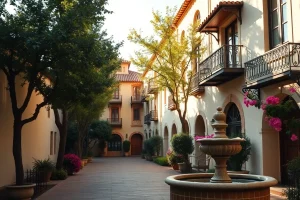
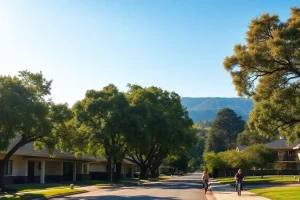
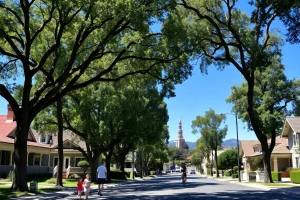
Professorville feels like a step back in time. Mature street trees—coast live oaks, camphor, and liquidambar—form a continuous canopy over narrow, curb-less streets. Sidewalks are often separated from the road by deep planting strips, and front gardens spill over with roses, lavender, and native grasses. The pace is slow, with residents frequently seen walking dogs, pushing strollers, or chatting on front porches.
The neighborhood is overwhelmingly residential, with no commercial establishments within its boundaries. This contributes to a remarkably quiet atmosphere, broken only by the occasional train horn from the nearby Caltrain corridor. The architectural cohesion is striking: block after block of well-preserved homes from the 1890s through the 1920s, punctuated by a few later infill structures that generally respect the scale and setbacks of their older neighbors. There is a palpable pride of place, fostered by an active neighborhood association and a shared commitment to preservation.
History
Professorville’s story begins in the early 1890s, shortly after the founding of Stanford University in 1891. Land that had been part of the Rancho Rinconada del Arroyo de San Francisquito was subdivided and marketed to faculty members. The first houses were built around 1892, and by 1910 the neighborhood was firmly established as the preferred address for Stanford professors, hence the name.
The district is nationally significant for several reasons. It contains the Hewlett-Packard garage at 367 Addison Avenue, where Bill Hewlett and Dave Packard started their electronics company in 1939—an event widely recognized as the birthplace of Silicon Valley. The garage is a designated California Historical Landmark and is listed on the National Register of Historic Places individually. The broader Professorville Historic District was added to the National Register in 1979, recognized for its concentration of architecturally distinguished homes and its association with the early development of Palo Alto and Stanford University.
“The garage at 367 Addison Avenue is the single most important site in the history of Silicon Valley. It was here that two young engineers with $538 in capital created the company that would set the template for the high-tech revolution.” — Palo Alto Stanford Heritage
Local preservation efforts intensified in the 1970s and 1980s as teardowns threatened the historic fabric. In 1991, the City of Palo Alto adopted an interim historic preservation ordinance, and Professorville was later designated a local historic district, imposing design review on exterior alterations and demolitions.
Housing and architecture
Professorville’s housing stock is a living museum of early 20th-century American residential architecture. The dominant styles include:
- Colonial Revival: Symmetrical facades, columned porches, and multi-pane windows, often with side-gabled roofs.
- Craftsman Bungalow: Low-pitched gable roofs, exposed rafter tails, wide front porches with tapered columns, and extensive use of natural wood.
- Queen Anne: Asymmetrical massing, decorative shingles, bay windows, and wrap-around porches (mostly from the earliest phase, 1890s).
- Shingle Style: Continuous wood shingle cladding, gambrel roofs, and minimal ornamentation.
- Tudor Revival: Steeply pitched roofs, half-timbering, and tall, narrow windows (less common, but present).
Lot sizes are generous for the area, typically 6,000 to 10,000 square feet, with houses set back 20 to 30 feet from the street. Many homes retain original details such as clapboard siding, divided-light windows, and built-in cabinetry. Renovations and additions are common but must undergo historic review to ensure compatibility with the district’s character.
Home prices in Professorville are among the highest in Palo Alto, reflecting the historic cachet, location, and scarcity. As of 2025, median sale prices typically exceed $4 million, with larger, fully restored properties reaching well above $6 million. The market is competitive, with many homes selling off-market or through pre-emptive offers.
Parks and natural features
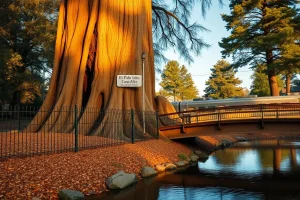
Professorville itself contains one small public park: Professorville Park, a pocket park at the corner of Addison Avenue and Waverley Street. It features a lawn, benches, a drinking fountain, and a small play structure, shaded by a magnificent coast live oak. It serves as an informal gathering spot for families and a rest point for walking tours.
Just outside the neighborhood’s southern boundary lies Rinconada Park, one of Palo Alto’s largest and most popular parks, with a swimming pool, tennis courts, playgrounds, and the Palo Alto Art Center. To the north, Eleanor Pardee Park offers additional green space, a community garden, and picnic areas. The neighborhood’s tree canopy itself functions as a linear park, with streets like Waverley and Cowper providing a continuous, shaded pedestrian experience.
Schools and community facilities
Professorville is served by the highly regarded Palo Alto Unified School District (PAUSD). Assigned schools include:
- Addison Elementary School (650 Addison Avenue) – located directly on the southern edge of the neighborhood, a California Distinguished School with strong parent involvement.
- Frank S. Greene Jr. Middle School (formerly Jordan Middle School) – about 0.7 miles south, offering a robust STEM and arts curriculum.
- Palo Alto High School (Paley) – approximately 0.5 miles south, consistently ranked among the top public high schools in California.
Several private schools are nearby, including International School of the Peninsula and Castilleja School (an all-girls secondary school). The Palo Alto Children’s Library and the main Palo Alto Library (Rinconada branch) are within walking distance. The Palo Alto Art Center, adjacent to Rinconada Park, offers classes, exhibitions, and community events.
Transportation and walkability
Professorville is exceptionally walkable and bike-friendly. The flat terrain, calm streets, and extensive tree cover make walking a pleasure. Most daily needs can be met on foot or by bicycle in adjacent downtown Palo Alto, just a 10- to 15-minute walk south along Waverley or Cowper streets.
Public transit options include:
- Caltrain: The Palo Alto station is at University Avenue, about 0.8 miles southeast, providing commuter rail service to San Francisco and San Jose.
- VTA Bus: Routes 22 and 522 run along El Camino Real (a few blocks west), connecting to Stanford, Mountain View, and San Jose.
- Palo Alto Link: The city’s free shuttle circulates through downtown and the Caltrain station, with stops near the neighborhood’s edge.
Major roads bounding the district—Embarcadero Road and Middlefield Road—carry significant traffic, but the interior streets are low-volume and often lack center lines, reinforcing the residential feel. Bike lanes on Middlefield and dedicated paths through Rinconada Park provide safe cycling routes to Stanford and beyond.
Shops and everyday services
There are no commercial businesses within Professorville’s boundaries, a deliberate feature that preserves its residential tranquility. However, the neighborhood is immediately adjacent to two vibrant commercial districts:
- Downtown Palo Alto (University Avenue and surrounding streets): A dense mix of independent bookstores, cafes, fine dining, boutiques, a farmers’ market (Saturdays on Gilman Street), and essential services like grocery stores (Whole Foods, Trader Joe’s) and pharmacies.
- California Avenue Business District (about 1 mile south): A more laid-back shopping street with restaurants, a Sunday farmers’ market, and specialty shops.
For quick errands, a small commercial node at Middlefield and Addison includes a coffee shop, dry cleaner, and convenience store just steps from the neighborhood’s western edge.
Notable landmarks
Several sites anchor Professorville’s identity:
- Hewlett-Packard Garage (367 Addison Avenue): The modest 12-by-18-foot shed where HP was founded. It is privately owned but visible from the street; interpretive signage tells the story. The HP Garage is a pilgrimage site for tech enthusiasts.
- Dunker House (420 Lincoln Avenue): A striking 1905 Colonial Revival mansion built for a Stanford professor, noted for its grand portico and formal gardens.
- Norris House (1247 Cowper Street): A well-preserved Craftsman bungalow from 1910, exemplifying the style’s emphasis on handcrafted detail.
- Professorville Park: The neighborhood’s only public green space, with a historic marker and a community bulletin board.
- Waverley Street Streetscape: The entire length of Waverley between Embarcadero and Addison is a designated “heritage street,” lined with some of the oldest and most architecturally significant homes.
Current planning issues
As of 2025, several planning and preservation topics are active in Professorville:
- Historic preservation vs. housing needs: Tensions persist between the desire to protect the district’s character and regional pressure to increase housing density. Proposals for lot splits, second units (ADUs), and larger additions must navigate strict historic design guidelines.
- Undergrounding utilities: The neighborhood association has long advocated for burying overhead power and telecommunication lines to improve aesthetics and safety, but funding and coordination with the city remain challenges.
- Traffic calming on Embarcadero and Middlefield: Residents continue to push for enhanced pedestrian crossings and speed mitigation measures along the district’s busier boundary streets, especially near schools.
- Climate adaptation and tree canopy: The aging tree canopy requires proactive management to address drought stress and disease, with the city and residents collaborating on a replanting plan that respects the historic landscape.
What residents should know
Living in Professorville comes with unique responsibilities and rewards:
- Historic district rules: Any exterior changes visible from the public right-of-way—including windows, roofing, paint color, and landscaping that affects the front setback—require review and approval from the city’s Historic Resources Board. This process can add time and cost to renovations but helps maintain property values and neighborhood character.
- Strong community network: The Professorville Neighborhood Association (PNA) is active, organizing annual block parties, historic home tours, and advocacy efforts. New residents are encouraged to join.
- Wildlife: The mature trees and proximity to creeks mean residents regularly see squirrels, raccoons, opossums, and a variety of birds, including hawks and owls. Occasional deer wander in from the foothills.
- Noise: While generally quiet, the neighborhood experiences some train horn noise from the Caltrain corridor, particularly at night. Homes closer to the tracks may have additional sound insulation.
- Parking: Most homes have driveways and garages, but street parking is limited and subject to residential permit zones during downtown events. Guest parking can be tight.
Nearby neighborhoods
| Neighborhood | Distance | Key Characteristics |
|---|---|---|
| Downtown Palo Alto | 0.3 miles south | Vibrant commercial core, high-end retail, restaurants, Caltrain station, condos and apartments |
| Crescent Park | 0.5 miles northeast | Exclusive, larger lots, early 20th-century estates, lush landscaping, no commercial uses |
| Old Palo Alto | 0.7 miles southwest | Wide streets, large homes, mix of historic and mid-century, close to Stanford and Rinconada Park |
| Community Center | 0.4 miles north | Home to Palo Alto Art Center, Children’s Library, and Rinconada Park; mix of single-family homes and townhouses |
| Midtown | 1.5 miles south | Post-war ranch homes, more affordable (relatively), family-oriented, close to shopping on Middlefield |
FAQ
What makes Professorville historically significant?
Professorville is significant as a remarkably intact early suburban residential district developed for Stanford University faculty beginning in the 1890s. It contains the HP Garage, birthplace of Silicon Valley, and a concentration of high-style Colonial Revival, Craftsman, and Queen Anne homes. The district was listed on the National Register of Historic Places in 1979 and is a locally designated historic district.
Is Professorville a good place for families?
Yes, Professorville is highly sought-after by families. It offers top-rated Palo Alto Unified schools (Addison Elementary, Greene Middle, Palo Alto High), quiet streets with little through traffic, a small neighborhood park, and a strong sense of community. The walkable proximity to downtown and Rinconada Park adds to its family appeal, though the high cost of housing is a significant barrier.
Can you visit the HP Garage?
The HP Garage at 367 Addison Avenue is privately owned and not open for interior tours, but it is fully visible from the public sidewalk. Interpretive signage provides historical context. The site is a popular stop on self-guided walking tours, and the exterior can be photographed freely. Respect the privacy of the current residents.
Are there any restrictions on remodeling homes in Professorville?
Yes. Because Professorville is a local historic district, any exterior work visible from the street—including window replacement, roofing, paint color, additions, and demolition—requires a Historic Resources Board review and a Certificate of Appropriateness. The guidelines aim to preserve the district's architectural integrity while allowing sensitive updates. Interior renovations generally do not require historic review unless they affect the exterior appearance.
Leave a Reply