Short Answer
Location
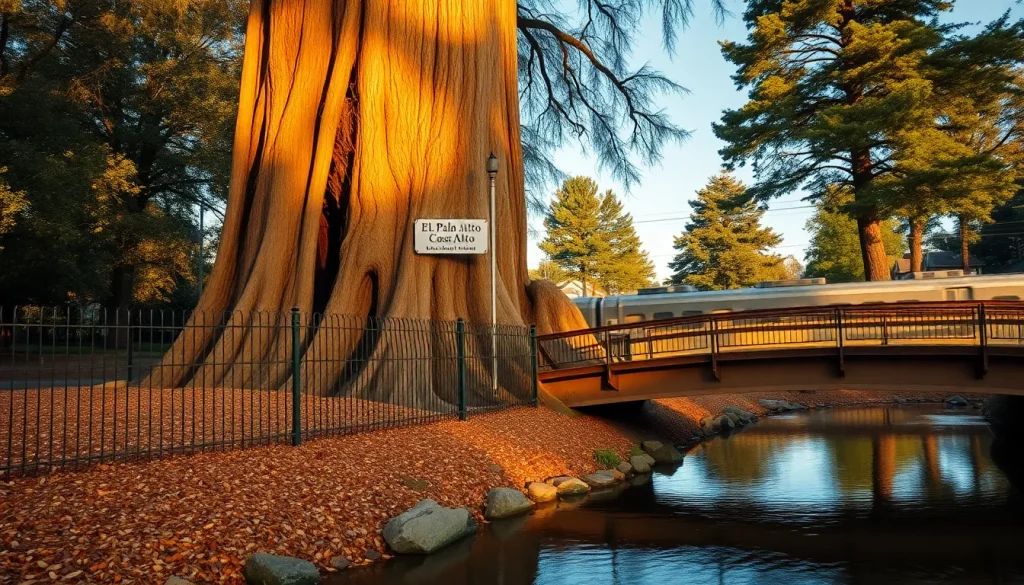
El Palo Alto Park is situated at the northwest corner of Palo Alto, California, at the intersection of Alma Street and Palo Alto Avenue, adjacent to the Menlo Park border. The park occupies a slender 0.6-acre (0.24-hectare) strip along the eastern bank of San Francisquito Creek, which forms the boundary between Santa Clara and San Mateo counties. The tree itself stands at coordinates 37°26′49″N 122°10′12″W, its roots anchored in the alluvial soil of the creek bed. The site is framed by a pedestrian bridge to the north, the Caltrain railroad tracks to the east, and the quiet residential streets of the Crescent Park neighborhood to the south. Despite its modest size, the park is a prominent waypoint along the regional San Francisquito Creek Trail and a defining feature of the city’s historical landscape.
Why It Is Significant
El Palo Alto is far more than an ancient tree; it is the living namesake of the City of Palo Alto and a designated California Historical Landmark (No. 2). Its significance spans natural history, indigenous heritage, European exploration, and modern urban identity. For centuries, the towering redwood served as a prominent navigational landmark for the Ohlone people, who traversed the creek corridor between San Francisco Bay and the Santa Cruz Mountains. In November 1769, the Spanish Portolá expedition—the first European overland journey through California—camped beside the tree and christened the site “El Palo Alto,” meaning “the tall tree.” This encounter marked the beginning of the region’s recorded history. Today, the tree stands as a rare, millennium-old coast redwood surviving in an urban setting, a testament to both natural resilience and community stewardship. It embodies the intersection of ecology, history, and civic pride, making it one of the most cherished landmarks on the San Francisco Peninsula.
Historical Timeline
| Date | Event |
|---|---|
| c. 900 CE | Coast redwood seedling takes root on the banks of San Francisquito Creek, beginning a life that will span more than a millennium. |
| Pre-1769 | The tree is a well-known landmark for the Puichon Ohlone tribe, who use the creek as a travel corridor and resource area. |
| November 6–10, 1769 | The Portolá expedition, led by Gaspar de Portolá and accompanied by Franciscan missionary Juan Crespí, camps at the creek. Crespí records the “palo alto” in his diary, giving the tree its enduring name. |
| 1850s–1860s | American settlers arrive, establishing farms and logging operations. The tree is spared from logging due to its landmark status and perhaps its twin trunks, which reduced its commercial value. |
| 1887 | Leland Stanford founds Stanford University on nearby land, accelerating development and bringing the railroad directly past the tree. |
| 1894 | The City of Palo Alto incorporates, taking its name directly from the historic redwood. |
| 1951 | El Palo Alto is designated California Historical Landmark No. 2, one of the first sites to receive state recognition. |
| 1950s–1960s | Severe decline sets in: the tree’s health deteriorates due to railroad construction damage to roots, lowered water table from nearby wells, and air pollution. One of the twin trunks dies and is removed. |
| 1970s–1990s | Community-led preservation efforts begin, including installation of a protective fence, soil aeration, and regular arborist care. |
| 2004 | A comprehensive health assessment by Barrie Coate & Associates reveals significant stress but confirms the tree can survive with intensive management. |
| 2010s–Present | Ongoing restoration projects include deep-root irrigation, mulching, and monitoring. The city and community groups collaborate to ensure the tree’s legacy endures. |
Architectural or Natural Characteristics
The Tree
El Palo Alto is a coast redwood (Sequoia sempervirens), a species renowned as the tallest on Earth. The tree currently stands approximately 110 feet (33.5 meters) tall, a fraction of its original estimated height of 162 feet (49 meters). The reduction occurred when the top died back due to stress and was later trimmed for safety. The trunk measures about 6 feet (1.8 meters) in diameter at breast height, with a circumference of roughly 19 feet (5.8 meters). Its bark is the characteristic thick, fibrous, reddish-brown armor of redwoods, deeply furrowed with age. The crown, though diminished, still produces healthy foliage, with feathery, dark green needles that filter the California sunlight.
Historically, the tree was a twin-trunked specimen—a rare growth form in redwoods. The second trunk, which grew from the same root system, succumbed to environmental pressures and was removed in the mid-20th century. A visible scar on the remaining trunk marks the site of the lost twin. The root system, shallow and wide-spreading as is typical of redwoods, extends beneath the creek bed and the adjacent railroad embankment, making it vulnerable to compaction and hydrological changes.
The Park
El Palo Alto Park is a minimalist landscape designed to frame and protect the tree. A low wrought-iron fence encircles the trunk, keeping visitors at a respectful distance to prevent soil compaction. A paved pathway leads from the street to a viewing plaza with interpretive signage. A bronze plaque mounted on a stone pedestal designates the site as California Historical Landmark No. 2. The park is shaded by a few younger trees, but the redwood dominates the space, its massive form contrasting with the suburban backdrop. The adjacent San Francisquito Creek, lined with willows and oaks, provides a riparian corridor that hints at the landscape the tree knew for centuries.
Cultural Meaning
El Palo Alto is woven into the identity of the city that bears its name. The tree appears on the official city seal, where it is depicted as a twin-trunked redwood beside a railroad and a university tower, symbolizing the three pillars of Palo Alto’s heritage: nature, transportation, and education. For residents, the tree is a touchstone of continuity, a living link to a pre-industrial past in a region defined by relentless innovation. It has inspired generations of environmental activism, serving as a rallying point for creek restoration and urban forestry initiatives. The tree also holds deep, though often understated, significance for the descendants of the Ohlone people, for whom it remains a marker of ancestral lands and a reminder of a landscape radically transformed. In the broader narrative of Silicon Valley, El Palo Alto stands as a quiet counterpoint to the mythology of disruption—a symbol of endurance, patience, and the deep time of the natural world.
Visiting Information
- Address: 117 Palo Alto Avenue, Palo Alto, CA 94301 (the park is at the corner of Alma Street and Palo Alto Avenue).
- Hours: Open daily from dawn to dusk. No lighting is provided, so visits after dark are not recommended.
- Admission: Free.
- Facilities: None. There are no restrooms, drinking fountains, or picnic areas. The site is a small viewing park only.
- Best Time to Visit: Morning light illuminates the tree beautifully, and weekdays are quieter. Spring brings lush greenery along the creek.
- Nearby Attractions: The Palo Alto Baylands Nature Preserve, Stanford University campus, and the downtown Palo Alto shopping and dining district are all within a short drive or bike ride.
- Parking: Limited free street parking is available on Palo Alto Avenue and adjacent residential streets. Respect neighborhood parking regulations.
Accessibility
The park is accessible via a flat, paved sidewalk from the street to the viewing area. The path is wheelchair-friendly, and the interpretive plaque is mounted at a readable height. However, the immediate area around the tree is unpaved and may be uneven. There are no designated accessible parking spaces directly at the park, but the adjacent street parking is generally level. Public transportation is available via Caltrain (Palo Alto station is approximately 1 mile south) and Santa Clara Valley Transportation Authority (VTA) bus routes 22 and 522 along El Camino Real, with a short walk to the site. The park’s compact size makes it easy to visit in a brief stop, but those with mobility challenges should be aware that no seating is provided.
Preservation Status
El Palo Alto is under the stewardship of the City of Palo Alto’s Public Works Department, with regular monitoring by certified arborists. The tree is classified as a “heritage tree” under municipal code, affording it legal protection from removal or harm. Current preservation strategies include deep-root irrigation to combat drought stress, soil aeration to alleviate compaction from historical railroad construction, and annual health assessments. A volunteer group, the “El Palo Alto Preservation Committee,” works alongside the city to raise funds and awareness. Despite these efforts, the tree faces ongoing threats: prolonged drought, rising temperatures, and the ever-present risk of root damage from nearby infrastructure. The city has invested in a dedicated water line to ensure the tree receives adequate moisture even during water restrictions. While the redwood’s condition is stable, arborists caution that its long-term survival depends on continued, adaptive management in the face of climate change.
Common Misconceptions
Map
FAQ
How old is the El Palo Alto tree?
The tree is estimated to be over 1,100 years old, dating to approximately 900 CE, based on growth ring analysis of similar redwoods and historical records.
Can I touch the tree or walk up to it?
No. A protective fence surrounds the tree to prevent soil compaction and root damage. Visitors can view the tree from a paved plaza just a few feet away.
Is the tree still alive and healthy?
Yes, the remaining trunk is alive and produces new growth annually. However, it is considered stressed due to past environmental damage and requires ongoing arboricultural care.
Why is it called El Palo Alto?
The name is Spanish for “the tall tree.” It was given by the Portolá expedition in 1769 when they camped beside the towering redwood, which served as a prominent landmark.
Is there an entrance fee or guided tours?
The park is free and open to the public. There are no regular guided tours, but interpretive signage provides historical context. The site is self-guided.

Leave a Reply