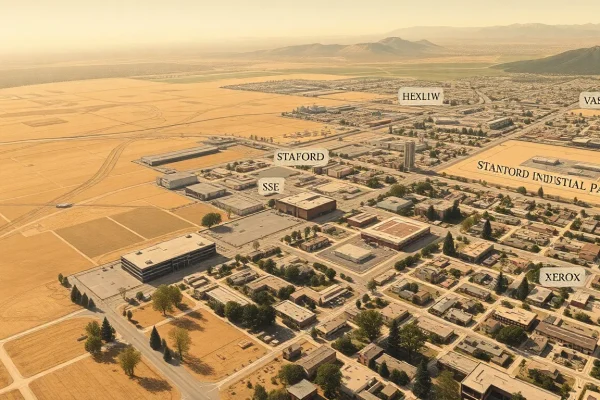
The Stanford Industrial Park: How a University’s Land Experiment Engineered Silicon Valley
In 1951, Stanford University leased a corner of its sprawling land holdings to a fledgling electronics firm, igniting a transformation that would turn the Santa Clara Valley from the ‘Valley of Heart’s Delight’ into the global epicenter of technology. The Stanford Industrial Park became the physical and symbolic heart of Silicon Valley, a carefully planned landscape where university research, venture capital, and corporate innovation fused into a new model of economic development. Its legacy is etched not only in the semiconductor chips and software that emerged from its low-slung buildings, but in the very pattern of suburban office parks, car-dependent commutes, and the displacement of agricultural communities that followed.