Short Answer
Location
Professorville Historic District is situated in the heart of Palo Alto, California, immediately southeast of the Stanford University campus. The district is roughly bounded by Embarcadero Road to the north, El Camino Real to the east, Addison Avenue to the south, and Waverley Street to the west. This approximately 100-acre residential enclave lies within walking distance of downtown Palo Alto and the Stanford University main quad, making it a seamless blend of academic and community life. The neighborhood’s central coordinates are 37.4419° N, 122.1600° W.
Why It Is Significant
Professorville stands as a remarkably intact example of an early academic suburb, directly tied to the founding and growth of Stanford University. Its significance is threefold: it is a living archive of residential architecture from the 1890s through the 1930s, a physical manifestation of the close-knit intellectual community that defined Stanford’s early decades, and a pioneering model of faculty housing that influenced university town planning nationwide. The district was listed on the National Register of Historic Places in 1980 and designated a local historic district by the City of Palo Alto, ensuring its preservation for future generations.
Historical Timeline
| Year | Event |
|---|---|
| 1891 | Stanford University opens; early faculty settle in nearby Palo Alto, some building homes in what would become Professorville. |
| 1893 | First houses constructed along Lincoln and Kingsley Avenues, including the residence of Professor John C. Branner. |
| 1905–1915 | Peak building period; the Craftsman bungalow becomes the dominant style, championed by architect Arthur B. Clark and others. |
| 1910 | Professorville’s name enters common usage, reflecting the concentration of Stanford faculty. |
| 1920s–1930s | Colonial Revival and Period Revival styles gain popularity; the neighborhood reaches near-complete build-out. |
| 1979 | Palo Alto Stanford Heritage (PAST) formed, advocating for the district’s recognition and protection. |
| 1980 | Professorville listed on the National Register of Historic Places. |
| 2005 | City of Palo Alto adopts Professorville Historic District Design Guidelines to regulate alterations and new construction. |
Architectural or Cultural Characteristics
Predominant Architectural Styles
The district is a veritable outdoor museum of early 20th-century American residential architecture. The most prevalent styles include:
- Craftsman Bungalow: Characterized by low-pitched gabled roofs, wide overhanging eaves with exposed rafter tails, decorative knee braces, and spacious front porches supported by tapered square columns. Interiors emphasize natural woodwork, built-in cabinetry, and open floor plans.
- Colonial Revival: Symmetrical façades, accentuated front doors with decorative crowns or pediments, multi-pane double-hung windows, and side-gabled or hipped roofs. These homes often feature classical columns and restrained ornamentation.
- Shingle Style: Continuous wood shingle cladding wrapping the entire exterior, asymmetrical massing, and broad porches. This style bridges the Queen Anne and Craftsman eras.
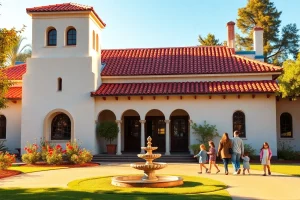
- Mission Revival: Stucco walls, red clay tile roofs, arched doorways, and bell-shaped parapets, reflecting California’s Spanish colonial heritage.
- Period Revivals: Tudor Revival (steeply pitched roofs, half-timbering) and Spanish Colonial Revival (courtyards, wrought iron details) appear in later infill.
Landscape and Streetscape
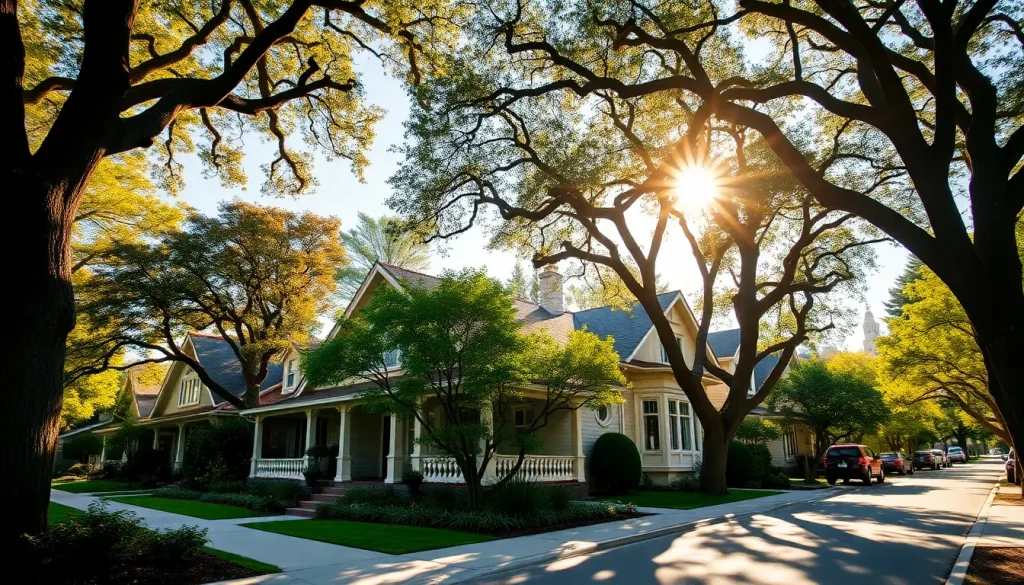
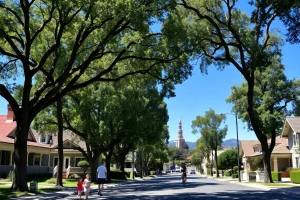
Professorville’s character is defined as much by its landscape as its buildings. Mature street trees—coast live oaks, American elms, and London plane trees—form a continuous canopy over narrow, curving streets. Deep front setbacks, often 20 to 30 feet, create a rhythmic pattern of gardens and lawns. Original sandstone curbs, early concrete sidewalks, and period streetlights survive in many blocks. The absence of sidewalks on some streets preserves a rustic, pre-automobile ambiance.
Notable Residences
- John C. Branner House (1893): One of the earliest homes, built for Stanford’s first geology professor and later university president. A transitional Queen Anne–Shingle style dwelling at 633 Kingsley Avenue.
- Arthur B. Clark House (1905): The architect’s own Craftsman bungalow at 345 Lincoln Avenue, a masterwork of the style with exquisite joinery and a sweeping porch.
- Herbert Hoover House (1919): While Hoover’s main residence was on campus, several faculty colleagues who later served in his administration lived in Professorville, including Secretary of the Interior Ray Lyman Wilbur, whose Colonial Revival home stands at 611 Kingsley Avenue.
Cultural Meaning
Professorville embodies the intellectual ferment of early Stanford and, by extension, the nascent Silicon Valley. The neighborhood was not merely a dormitory for academics; it was an incubator of ideas. Informal gatherings on front porches and in gardens fostered interdisciplinary collaboration that contributed to Stanford’s rise as a research powerhouse. The district’s name itself—a colloquialism that stuck—reflects the community’s self-aware identity as a “village of professors.”
“In Professorville, the boundaries between home and laboratory, between neighbor and colleague, were delightfully blurred. It was a place where a conversation over the fence could lead to a new department or a groundbreaking experiment.” — From Palo Alto: A Centennial History by Ward Winslow
Today, the district remains a symbol of Palo Alto’s commitment to preserving its heritage amid rapid technological change. It serves as a touchstone for residents and visitors seeking to understand the human-scale origins of a region now synonymous with global innovation.
Visiting Information
Self-Guided Walking Tour
Professorville is a public neighborhood best explored on foot. A self-guided tour can begin at the corner of Lincoln Avenue and Kingsley Avenue. The Palo Alto Stanford Heritage (PAST) organization offers downloadable tour maps and occasionally hosts docent-led walks. Key streets to include are Lincoln Avenue, Kingsley Avenue, and Ramona Street between Addison and Embarcadero.
Hours and Access
- The district is open to the public 24 hours a day as a residential neighborhood; however, visitors should respect private property and remain on public sidewalks.
- No interior access to homes except during special events such as the annual PAST Historic House Tour, typically held in the spring.
- Street parking is available but limited; observe posted restrictions. Public transit via Caltrain (Palo Alto station) and VTA buses is convenient.
Visitor Tips
- Wear comfortable walking shoes; the terrain is flat but the tour covers several blocks.
- Bring a camera with a wide-angle lens to capture the streetscapes and architectural details.
- Visit in spring when gardens are in bloom, or in autumn for golden foliage against the Craftsman wood tones.
- Combine your visit with a stroll through the Stanford University campus, a 15-minute walk away.
Accessibility
The neighborhood’s flat terrain and well-maintained public sidewalks make it largely accessible to visitors using wheelchairs or mobility aids. However, some older sidewalk sections may have uneven surfaces due to tree roots. Curb cuts are present at most intersections. There are no public restrooms or dedicated accessible facilities within the district itself; the nearest accessible restrooms are at nearby Peers Park or downtown Palo Alto establishments. Service animals are welcome. For those unable to walk the full tour, a driving route along the main streets still offers excellent views of the architecture.
Preservation Status
Professorville is protected by dual designation: it is both a National Register Historic District and a City of Palo Alto Historic District. The local ordinance, codified in the Palo Alto Municipal Code Chapter 16.49, requires review of exterior alterations, demolitions, and new construction by the Historic Resources Board. The 2005 Design Guidelines emphasize preserving character-defining features such as roof forms, porch configurations, window patterns, and landscape setbacks. Recent years have seen sensitive restorations and a few contemporary additions that respect the district’s scale and materials. The nonprofit Palo Alto Stanford Heritage actively monitors the district and advocates for its continued integrity.
Common Misconceptions
Map
FAQ
What is Professorville?
Professorville is a historic residential neighborhood in Palo Alto, California, known for its exceptional collection of early 20th-century homes built primarily by Stanford University faculty. It is listed on the National Register of Historic Places.
Can I tour the interiors of the homes?
The homes are private residences and not open to the public on a daily basis. However, the Palo Alto Stanford Heritage (PAST) organization hosts an annual house tour each spring, offering rare interior access to select properties.
Is Professorville a designated historic district?
Yes, it is both a National Register Historic District (since 1980) and a local City of Palo Alto Historic District, which provides legal protection against inappropriate alterations or demolition.
What architectural styles will I see?
The district is dominated by Craftsman bungalows and Colonial Revival homes, with notable examples of Shingle, Mission Revival, Tudor Revival, and Spanish Colonial Revival styles.
How do I get there using public transit?
Take Caltrain to the Palo Alto station. From there, it is a 15-minute walk or a short ride on VTA bus lines 22 or 522 to the El Camino Real and Embarcadero stop, then walk west into the neighborhood.
Leave a Reply