Short Answer
One-Sentence Summary
The 1906 earthquake, though centered far from Palo Alto, unleashed a seismic shock that shattered the sandstone spires of Stanford University, killed two people locally, and forced a radical architectural and institutional transformation that would ultimately shape the resilient, forward-looking character of the Palo Alto community.
Key Dates
| Date | Event |
|---|---|
| 1891 | Stanford University opens; Palo Alto founded as a temperance town. |
| 1899 | Memorial Arch completed as a grand entrance to the Main Quad. |
| April 18, 1906, 5:12 a.m. | Magnitude 7.9 earthquake strikes; severe shaking lasts 45–60 seconds. |
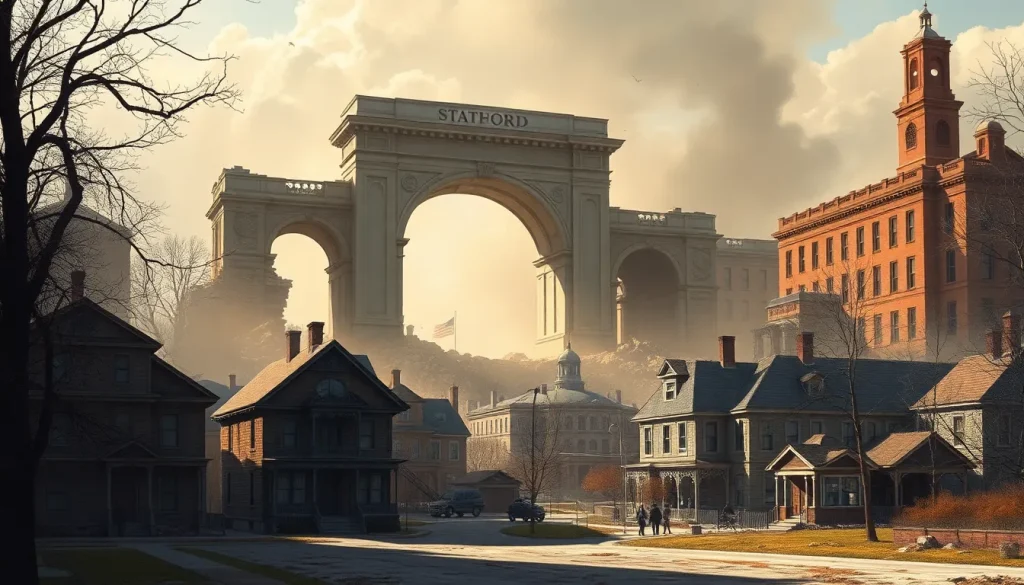
| April 18, 1906, morning | Memorial Arch collapses, killing student Junius Hanna; original Memorial Church heavily damaged. |
| April 19, 1906 | President David Starr Jordan surveys damage, vows to rebuild immediately. |
| Summer 1906 | Demolition of unsafe ruins begins; temporary wooden structures erected for fall classes. |
| 1907–1908 | Construction of new Memorial Church and other buildings in reinforced concrete begins. |
| 1913 | New Memorial Church dedicated, marking the symbolic completion of the campus restoration. |
| 1920s | Palo Alto adopts stricter building codes influenced by earthquake lessons. |
Geographic Setting
In 1906, Palo Alto occupied a flat alluvial plain between San Francisquito Creek and the tidal marshes of the Bay, approximately 30 miles south of San Francisco. The town’s grid, laid out by the Southern Pacific Railroad, stretched from the railroad tracks eastward toward the Bay. To the west, across the tracks and beyond the creek, rose the sandstone-clad buildings of Stanford University, nestled in the foothills of the Santa Cruz Mountains. The San Andreas Fault, the source of the earthquake, ran through those mountains roughly 15 miles to the west. The deep sedimentary soils of the plain amplified the shaking, a phenomenon not fully understood at the time. Contemporary accounts describe the ground moving in “waves like the ocean,” and the alluvial deposits contributed to the prolonged, rolling motion that proved so destructive to rigid masonry structures. The original townsite lay between present-day University Avenue and the Caltrain tracks, with the Stanford campus still dominating the western horizon. What was once marshland to the east is now the site of the Palo Alto Baylands Nature Preserve, but in 1906 it was a sparsely populated area of duck clubs and sloughs.
Origins
Palo Alto’s origins are inextricably linked to Stanford University. The town was incorporated in 1894, three years after the university opened, on land once part of the Rancho San Francisquito. Leland and Jane Stanford had chosen the site for their memorial university in 1885, envisioning a grand institution built in a distinctive California Romanesque style. The original campus, designed by Shepley, Rutan and Coolidge, featured a massive sandstone quadrangle, a towering Memorial Arch, and a church with a 190-foot spire. The town that grew up to serve the university was, by design, a “dry” community—alcohol sales were prohibited, a reflection of the Stanfords’ temperance ideals. By 1900, Palo Alto had a population of about 1,500, a figure that had grown to roughly 2,000 by 1906. The exact date of the first settlement is disputed, with some sources claiming a small community existed around the railroad stop as early as the 1870s, but the town’s formal identity crystallized only with the university’s arrival. Indigenous history in the area is older still; the Ohlone people had inhabited the region for millennia, and the name “Palo Alto” itself derives from a tall redwood tree that served as a landmark for Spanish explorers.
Growth and Community Life
On the eve of the earthquake, Palo Alto was a quiet college town. The university enrolled approximately 1,500 students, many of whom lived in campus dormitories or boarding houses in town. The commercial heart of Palo Alto lay along University Avenue, where wooden storefronts housed a bank, a drugstore, a grocery, and a few professional offices. The town boasted a public library, several churches, and a weekly newspaper, the Palo Alto Times. Social life revolved around university events, church socials, and the railroad station, which connected the community to San Francisco. Contemporary newspaper accounts reported that the Fourth of July celebration of 1905 drew over 1,000 people to the Stanford grounds for fireworks and speeches. The town’s fire department was volunteer, and its water supply came from a wooden tower near the station. There were no paved streets; the roads were oiled dirt. The university itself was a self-contained village, with its own power plant, water system, and dining halls. The sandstone quadrangle, though only 15 years old, had already become an iconic landmark, its archway framing the entrance to the “Farm.” Students and faculty lived in a rarefied atmosphere of academic pursuit, but the town also had its share of laborers who worked in the university’s sandstone quarries or on the railroad. The sound of quarrying was a constant backdrop to daily life, a reminder of the ongoing construction that had not yet finished when the earthquake struck.
Relationship with Nearby Powers
The relationship between Palo Alto and Stanford University was one of profound economic and cultural dependency. The university was the town’s largest employer and its raison d’être. The Southern Pacific Railroad, which had granted the land for the town, also exerted influence, but it was the university’s leadership—particularly President David Starr Jordan—that shaped local affairs. The earthquake tested this dynamic. When the disaster struck, Jordan immediately took charge of the university’s response, but the town was left to fend for itself in the first hours. There was no formal mutual aid agreement. However, the shared crisis quickly fostered cooperation: townspeople opened their homes to displaced students, and the university’s engineering faculty advised on the safety of damaged structures. The railroad played a critical role, bringing in relief supplies and carrying away refugees. Politically, the town’s temperance clause had already caused friction with some residents and with the nearby, more permissive community of Mayfield (later annexed). The earthquake, by reinforcing the need for coordinated rebuilding, strengthened the bonds between town and gown, though the university’s dominance was never in question. A subtle tension persisted: some townspeople felt that the university’s needs always came first, a sentiment captured in oral histories collected in the 1930s, where one resident recalled, “We were all Stanford’s servants, in a way, but after the quake we became partners—at least for a while.”
Annexation, Decline, or Transformation
The 1906 earthquake did not lead to annexation or decline for Palo Alto; rather, it triggered a profound transformation. The most visible change was architectural. The original Stanford buildings, constructed of unreinforced sandstone masonry, had failed catastrophically. According to the university’s own report, the Memorial Arch “crumbled like a sand castle,” and the church’s spire crashed through the roof. President Jordan, surveying the wreckage, famously declared, “We will rebuild, and we will rebuild better.” Within weeks, the university’s trustees committed to a new campus plan that abandoned the Richardsonian Romanesque style in favor of a more earthquake-resistant Mission Revival aesthetic, using reinforced concrete. The new Memorial Church, designed by Charles A. Coolidge, was completed in 1913 with a lower, more massive profile and a steel frame. The town of Palo Alto, though less physically altered, underwent a regulatory transformation. The city council, learning from the collapse of unreinforced masonry, gradually introduced stricter building codes. By the 1920s, new commercial buildings were required to have steel frames. The earthquake also accelerated the professionalization of the university’s administration and its shift toward a research-oriented model, which would eventually spawn the high-tech industries that define the region. The final city council meeting to adopt the new building code was held in a temporary wooden hall because the original town hall had been damaged, though not destroyed. According to the city inventory, the annexation agreement with Mayfield was still decades away, but the earthquake’s lessons in shared infrastructure and planning laid the groundwork for future consolidation.
What Remains Today
Visitors to Palo Alto and Stanford can still trace the scars and memorials of the 1906 earthquake. On the Stanford campus, the most poignant remnant is the site of the Memorial Arch: its foundation stones are visible, and a plaque marks the spot where student Junius Hanna died. The current Memorial Church should not be confused with the original; the 1913 structure stands on the same site but is an entirely different building. The Outer Quad, however, retains much of its original sandstone fabric, though it was heavily repaired. The “Angel of Grief” statue, originally part of the Stanford family mausoleum, was relocated and now stands near the church as a memorial to the victims. In Palo Alto, the Norris House at 235 University Avenue (now the Palo Alto History Museum) is a pre-1906 wood-frame residence that survived with minor damage. The Dunker House at 420 Lincoln Avenue also dates from the 1890s. The Palo Alto Tree, a coast redwood planted near the railroad station in the 1890s, survived the shaking and still stands as a living witness at the corner of University Avenue and Alma Street. No known photographs of the original town water tower survive, but its location is marked by a plaque on High Street. Archaeological evidence suggests that some foundations of collapsed outbuildings remain buried under the modern campus landscaping, occasionally uncovered during construction projects.
Historical Photographs and Maps
Several key visual sources document the disaster. The Stanford University Archives holds the “Stanford Earthquake Collection, 1906” (SC0101), which includes over 200 photographs taken by W.J. Hussey, a university astronomer, in the days immediately following the quake. These images show the collapsed arch, the shattered church, and the makeshift tent classrooms. A 1905 Sanborn fire insurance map of Palo Alto, held at the Library of Congress, reveals the pre-earthquake layout of the town’s wooden commercial district, which was largely intact after the quake. The 1908 Sanborn map shows the same area with notations of repaired chimneys and a new water tower. Perhaps the most evocative visual record is a series of panoramic photographs taken from the top of the damaged Encina Hall, looking down on the rubble-strewn quadrangle. These images, now digitized, capture the scale of destruction and the eerie emptiness of the campus in the days after the disaster. A 1908 Sanborn fire insurance map shows the original layout of the saloon district in nearby Mayfield, now buried under the California Avenue business district, providing a contrast to the dry town of Palo Alto.
Historiographical Notes
The story of the 1906 earthquake in Palo Alto has been told primarily through the lens of Stanford University. Early accounts, such as David Starr Jordan’s 1906 pamphlet “The Story of the Earthquake and Fire: Stanford University,” emphasized the heroic rebuilding and the resilience of the university community. These narratives, often written by university administrators, downplayed the town’s experience and the social tensions that the disaster exacerbated. For example, the temporary housing of students in town led to overcrowding and disputes over rent, which are absent from official histories. Recent revisionist work, such as that by local historian Steve Staiger, has sought to recover the voices of ordinary Palo Altans, using oral histories collected in the 1930s by the Palo Alto Historical Association. These oral histories indicate that many residents felt a sense of abandonment in the first hours, as all attention focused on the university. Additionally, the earthquake’s role in reshaping Stanford’s architectural identity has been reexamined by scholars who argue that the shift to Mission Revival was not merely pragmatic but also a deliberate rebranding of the university as a distinctly Californian institution. Early county histories, written by prominent landowners, tend to downplay the labor conflicts that actually defined the town’s final years before the quake, focusing instead on the triumphal narrative of recovery.
Sources and Archives
The most important repository for research on this topic is the Stanford University Archives, particularly the Stanford Earthquake Collection (SC0101) and the David Starr Jordan Papers (SC0058). The Palo Alto Historical Association, located in the Norris House, holds a rich collection of oral histories, photographs, and the complete run of the Palo Alto Times on microfilm. The California Historical Society in San Francisco has additional photographs and ephemera. For building-level detail, the Sanborn fire insurance maps for Palo Alto (1905, 1908, and later) are available through the Library of Congress and provide precise documentation of structural changes. The Bancroft Library at UC Berkeley holds the papers of Charles A. Coolidge, the architect of the new Memorial Church, which include correspondence about the rebuilding decisions. The Palo Alto City Clerk’s office retains the original city council minutes from 1906, which record the emergency meetings and the first discussions of building code reforms.
Related People and Places
David Starr Jordan (1851–1931): Stanford’s first president, an ichthyologist by training, who became the public face of the university’s recovery. His decisive leadership and fundraising efforts were instrumental in rebuilding, though his later involvement in the eugenics movement has complicated his legacy.
Junius Hanna (1885–1906): A Stanford junior from Iowa, Hanna was the only student killed in the earthquake. He was struck by falling stone from the Memorial Arch while running toward the quad. A plaque in his memory stands near the arch’s former site.
Jane Stanford (1828–1905): Though she died a year before the earthquake, her vision and the terms of the university’s founding grant shaped the rebuilding. The trustees were bound by her requirement that the campus be built in a “California style,” which they interpreted as Mission Revival after the quake.
Mayfield: The neighboring town to the south, which was not bound by temperance laws and thus had saloons. Mayfield was later annexed by Palo Alto in 1925, but in 1906 it served as a contrast to the dry, university-dominated town.
The Palo Alto Tree: A coast redwood (Sequoia sempervirens) planted near the railroad station in the 1890s. It survived the earthquake and became a symbol of the town’s endurance. It still stands at the corner of University Avenue and Alma Street.
FAQ
Was Palo Alto destroyed in the 1906 earthquake?
No. While Stanford University suffered catastrophic damage, the town of Palo Alto itself fared relatively well. Most residential and commercial buildings were wood-frame and survived, though many chimneys collapsed and the water tower fell. The town's population was not significantly displaced.
How many people died in Palo Alto during the 1906 earthquake?
Two fatalities were recorded locally: Stanford student Junius Hanna, who was struck by falling masonry from the Memorial Arch, and a worker in Palo Alto who was killed by a collapsing chimney. This was a fraction of the thousands who died in San Francisco.
What happened to Stanford University after the earthquake?
The earthquake destroyed many of Stanford's original sandstone buildings, including the Memorial Arch and the church. Under President David Starr Jordan, the university immediately began rebuilding, adopting reinforced concrete and a new Mission Revival style. The disaster ultimately spurred a modernization of the campus and its academic programs.
Are there any buildings in Palo Alto that survived the 1906 earthquake?
Yes. Several pre-1906 wood-frame houses still stand, such as the Norris House (now the Palo Alto History Museum) and the Dunker House. On the Stanford campus, parts of the Outer Quad survived, and the Encina Hall dormitory, though damaged, was repaired and still stands.

Leave a Reply