Short Answer
One-Sentence Summary
Mayfield, a once-independent railroad and saloon town south of Palo Alto, was annexed in 1925 after decades of tension with its dry neighbor and Stanford University, leaving behind a transformed commercial district and a legacy of contested identity that still echoes in the streetscapes of California Avenue.
Key Dates
| Date | Event |
|---|---|
| c. 1853 | Elisha Mayfield establishes a farm and stage stop on the San Francisco–San Jose road. |
| 1863 | San Francisco & San Jose Railroad opens a station named Mayfield, fixing the town’s nucleus. |
| 1891 | Stanford University opens; its founding grant prohibits alcohol within a 1.5-mile radius, excluding Mayfield. |
| 1894 | Palo Alto incorporates as a dry town, intensifying the contrast with wet Mayfield. |
| 1903 | Mayfield incorporates as a town to resist annexation and control its saloon revenues. |
| 1906 | Post-earthquake migration swells Mayfield’s saloon district, known as Whiskey Gulch. |
| July 1925 | Voters in both Mayfield and Palo Alto approve annexation; the measure passes in Mayfield by a narrow margin. |
| August 1925 | Annexation takes effect; Mayfield’s town government is dissolved. |
| January 1926 | Last saloons close under Palo Alto’s dry ordinance; Lincoln Avenue is renamed California Avenue. |
| 1930s–present | Gradual redevelopment erases most 19th-century fabric, but the California Avenue district retains a distinct identity. |
Geographic Setting
The original Mayfield townsite lay between present-day Page Mill Road and San Antonio Road, bounded on the east by the Southern Pacific Railroad tracks and on the west by the gradual rise of the Santa Cruz Mountains foothills. Adobe Creek meandered through the northern portion, and the landscape was a mosaic of oak savanna, grain fields, and orchards. The heart of the town clustered around the railroad depot at Lincoln Avenue—now California Avenue—and the parallel side streets of Birch and Sherman. What was once a seasonal wetland near the creek is now the site of the Mayfield Place cul-de-sac and the Mayfield School. Modern visitors can orient themselves by the California Avenue Caltrain station, which occupies the same site as the original 1863 depot, and by the commercial strip that still follows the historic street grid.
Origins
The area that became Mayfield lies within the ancestral territory of the Ohlone people, whose villages along San Francisquito Creek were documented by early Spanish expeditions. Following the secularization of the missions, the land was granted as Rancho San Francisquito. In the early 1850s, settler Elisha Mayfield acquired a portion of the rancho and established a stage stop and farm along the main road between San Francisco and San Jose. The exact date of the first non-indigenous dwelling is disputed; some sources claim a way station existed as early as 1850, while the first recorded deed dates to 1853. The arrival of the San Francisco & San Jose Railroad in 1863 transformed the sleepy crossroads. The railroad company platted a townsite and named the depot Mayfield, cementing the name. The station became a shipping point for wheat, hay, and later fruit from the surrounding orchards, attracting merchants, a blacksmith, and a small hotel.
Growth and Community Life
By the 1880s, Mayfield had a school, two churches, a general store, and a volunteer fire brigade. The town’s character changed dramatically with the opening of Stanford University in 1891. Leland Stanford’s deed of trust mandated that no alcohol be sold within a mile and a half of the campus, a boundary that fell just north of Mayfield. Palo Alto, incorporated three years later, enshrined the prohibition in its charter. Mayfield, lying outside the dry radius, became the nearest source of liquor for students, faculty, and railroad workers. Contemporary newspaper accounts reported that by 1905 the town of fewer than 1,000 residents supported twelve saloons, a brewery, and several boarding houses along Lincoln Avenue, a strip soon dubbed “Whiskey Gulch.” The Mayfield Brewery, founded in 1902, produced lager that was shipped as far as San Francisco. The town incorporated in 1903, largely to protect its saloon tax base from annexationist sentiment in Palo Alto. Census records from 1910 show a population of 1,200, a mix of German, Irish, and Italian immigrants, many employed by the railroad or the cannery. The Fourth of July celebration of 1912, according to the Mayfield Enterprise, drew over 2,000 people for a parade, baseball game, and fireworks, reflecting a robust civic pride. Yet social tensions simmered: temperance advocates, often aligned with the Methodist church, clashed with saloonkeepers and the town board, which depended on liquor license fees for road repairs and street lighting.
Relationship with Nearby Powers
Mayfield’s existence was defined by its asymmetrical relationship with Stanford University and the city of Palo Alto. The university’s temperance policy created an economic niche for Mayfield but also marked it as a moral threat in the eyes of Palo Alto’s civic leaders. As early as 1906, the Palo Alto Times editorialized that “the annexation of Mayfield is the only permanent solution to the liquor problem.” Mayfield’s trustees repeatedly rebuffed overtures, arguing that the town’s saloons were orderly and that annexation would bankrupt local businesses. The Southern Pacific Railroad, which owned the depot and considerable right-of-way, remained a silent but influential player; its freight traffic sustained the cannery and lumber yard, and any change in municipal governance threatened its freight rates. Stanford itself maintained an ambiguous stance—officially neutral, but its administrators quietly supported dry expansion. The dynamic was not merely political but cultural: Palo Alto saw itself as a model “university town” of educated, temperate citizens, while Mayfield was caricatured as a rough, working-class appendage. Oral histories collected in the 1930s indicate that many Mayfield residents resented being treated as a “vice district” and pointed to their own school, churches, and fraternal lodges as evidence of a stable community.
Annexation, Decline, or Transformation
The annexation campaign intensified after World War I, as Palo Alto sought to expand its tax base and eliminate the saloons once and for all. Pro-annexation forces in Mayfield, led by a faction of merchants who believed consolidation would bring better services, gathered signatures for a vote. According to the Santa Clara County Board of Supervisors records, the election was held on July 14, 1925. In Mayfield, the measure passed by a margin of 304 to 270—a difference of only 34 votes—while Palo Alto voters approved it overwhelmingly. The annexation took effect on August 7, 1925. The final meeting of the Mayfield town board was held in the back room of a saloon on Lincoln Avenue, as the town hall had already been sold to a private buyer. Within six months, Palo Alto’s dry ordinance was enforced; the last saloon closed its doors on January 1, 1926. Lincoln Avenue was renamed California Avenue, and the old street names were gradually changed to conform to Palo Alto’s grid. The Mayfield Brewery was shuttered and later converted into a warehouse. The town’s identity was systematically erased from official maps, though residents continued to call the area Mayfield for decades.
What Remains Today
Despite the erasure, a careful observer can still trace the outlines of the lost town. The California Avenue business district, between El Camino Real and the Caltrain tracks, preserves the scale and rhythm of the old Lincoln Avenue. The building at 315 California Avenue, now a restaurant, occupies the site of the Mayfield Hotel, which burned in 1912; its replacement, constructed in 1913, still stands. The former Mayfield Brewery building at 250 California Avenue was remodeled into offices but retains its industrial brick shell. Mayfield School, built in 1905 and later expanded, continues to operate as a public school on Middlefield Road. The Mayfield Place cul-de-sac, laid out in the 1950s, marks the approximate location of the original town hall and fire station. A bronze plaque installed by the Palo Alto Historical Association at the corner of California Avenue and Birch Street commemorates the annexation. Several Victorian-era cottages survive on Sherman and Birch avenues, their lots subdivided but their gables and porches still visible. The current Caltrain station, rebuilt in the 1990s, should not be confused with the original 1863 depot, which was demolished in the 1920s; however, the station’s location and the adjacent parking lot follow the historic right-of-way. No known photographs of the original depot interior survive, but exterior views exist in the Palo Alto Historical Association collection.
Historical Photographs and Maps
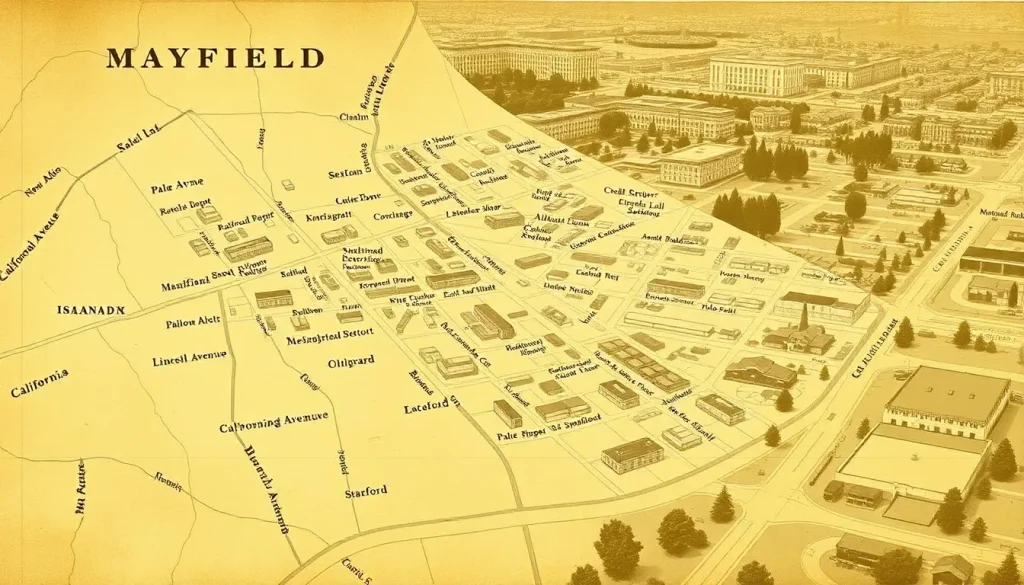
A 1908 Sanborn fire insurance map, held by the Library of Congress, shows the original layout of the saloon district along Lincoln Avenue, with notations for “saloons,” “lodging,” and “livery.” The map reveals that nearly every other storefront between Birch and Sherman was a drinking establishment, a density now buried under the widened California Avenue. A panoramic photograph taken in 1915, preserved in the Stanford University Archives, depicts the Mayfield Volunteer Fire Department posed in front of the two-story town hall, with the brewery smokestack visible in the background. The image captures the town’s civic pride and its industrial scale. A 1925 aerial survey, commissioned by Palo Alto in preparation for annexation, shows the transition zone between the orchard-lined streets of Mayfield and the orderly subdivisions of Palo Alto; the photograph is now part of the Santa Clara County Surveyor’s Office records and provides the clearest visual evidence of the town’s extent just before its dissolution.
Historiographical Notes
The story of Mayfield has been told primarily through the lens of Palo Alto’s booster histories, which emphasize the saloons as a public nuisance and the annexation as a triumph of progressive reform. Early county histories, such as J.P. Munro-Fraser’s 1881 History of Santa Clara County, barely mention Mayfield, reflecting its marginal status. The 1953 centennial history of Palo Alto, written by city librarian Margaret Thompson, frames the annexation as a necessary step in the “civilizing” of the South Peninsula. Revisionist work since the 1980s, notably by local historian Ward Winslow in Mayfield: The Town That Was (1993), has recovered the voices of Mayfield residents and highlighted the class and cultural dimensions of the conflict. Oral histories collected by the Palo Alto Historical Association in the 1970s capture the lingering resentment of old-timers who felt their town had been “stolen.” The official record remains silent on the fate of the saloonkeepers and their families, many of whom left the area after 1926. Recent scholarship has begun to examine Mayfield as a case study in the temperance-driven municipal imperialism that reshaped many American suburbs in the early twentieth century.
Sources and Archives
The most important repository is the Palo Alto Historical Association, which holds the Mayfield Enterprise newspaper files, city directories, and the annexation election records. Stanford University Special Collections houses the Timothy Hopkins papers, which include correspondence about railroad land sales and the temperance boundary. The California Digital Newspaper Collection provides searchable access to the Palo Alto Times and the San Jose Mercury News for the period 1890–1930. Sanborn fire insurance maps for 1908 and 1925 are available through the Library of Congress digital portal. The Santa Clara County Archives holds the official annexation agreement and the minutes of the Mayfield town board, 1903–1925. Oral history transcripts from the “Mayfield Remembered” project (1972–1975) are available at the Palo Alto City Library.
Related People and Places
Elisha Mayfield (c. 1810–1880): The farmer and stage-station keeper whose name became the town’s. Little is known of his later life; he sold his holdings in the 1860s and moved to Santa Cruz County. Timothy Hopkins (1859–1936): Adopted son of railroad magnate Mark Hopkins, he acted as the Southern Pacific’s land agent and platted much of the Mayfield townsite. His papers reveal the railroad’s quiet influence on annexation politics. John F. Parkinson (1872–1945): Mayfield’s last mayor, a blacksmith who opposed annexation and later became a Palo Alto councilman. His oral history, recorded in 1938, is a key source for the anti-annexation perspective. Leland Stanford (1824–1893): The university founder whose temperance clause inadvertently created Mayfield’s saloon economy. Whiskey Gulch: The nickname for the Lincoln Avenue saloon district, now the 300–400 block of California Avenue. Searsville: Another lost town in the region, submerged by the Searsville Reservoir, often compared to Mayfield as an example of a vanished community. Professorville: The dry, affluent Palo Alto neighborhood that embodied the cultural opposite of Mayfield, its residents among the most vocal annexation supporters.
FAQ
Why did Palo Alto annex Mayfield?
Palo Alto sought to expand its tax base, eliminate the saloons that violated the spirit of Stanford University's dry radius, and unify the South Peninsula under a single municipal government. The annexation was framed as a progressive reform to curb vice and improve services.
What happened to Mayfield's saloons after annexation?
Palo Alto's dry ordinance was enforced within months. The last saloon closed on January 1, 1926. Many saloonkeepers left the area, and the buildings were converted to other commercial uses or demolished over time.
Are there any original Mayfield buildings still standing?
Yes, several structures survive. The 1913 building at 315 California Avenue replaced the burned Mayfield Hotel. The former Mayfield Brewery building at 250 California Avenue retains its brick shell. Mayfield School, built in 1905, still operates. A few Victorian cottages remain on side streets.
What was the relationship between Mayfield and Stanford University?
Stanford's founding grant prohibited alcohol within 1.5 miles of the campus, which excluded Mayfield. This made Mayfield the nearest source of liquor for students and faculty, creating an economic boom for saloons but also a moral stigma that fueled annexation efforts.
Leave a Reply