Short Answer
One-Sentence Summary
The Japanese American community of Palo Alto, rooted in the agricultural nurseries and domestic service of the early 20th century, was forcibly uprooted by wartime incarceration in 1942, yet it reestablished itself around the Palo Alto Buddhist Temple, leaving a resilient cultural legacy that persists in the city’s landscape and civic memory.
Key Dates
| Date | Event |
|---|---|
| c. 1890s | First Japanese immigrants arrive in the Palo Alto area, primarily as agricultural laborers and domestic workers. |
| 1903 | The Palo Alto Japanese Association is formed to provide mutual aid and cultural continuity for the growing community. |
| 1913 | California’s Alien Land Law prohibits Japanese immigrants from owning land, pushing many into leasehold farming and nursery operations. |
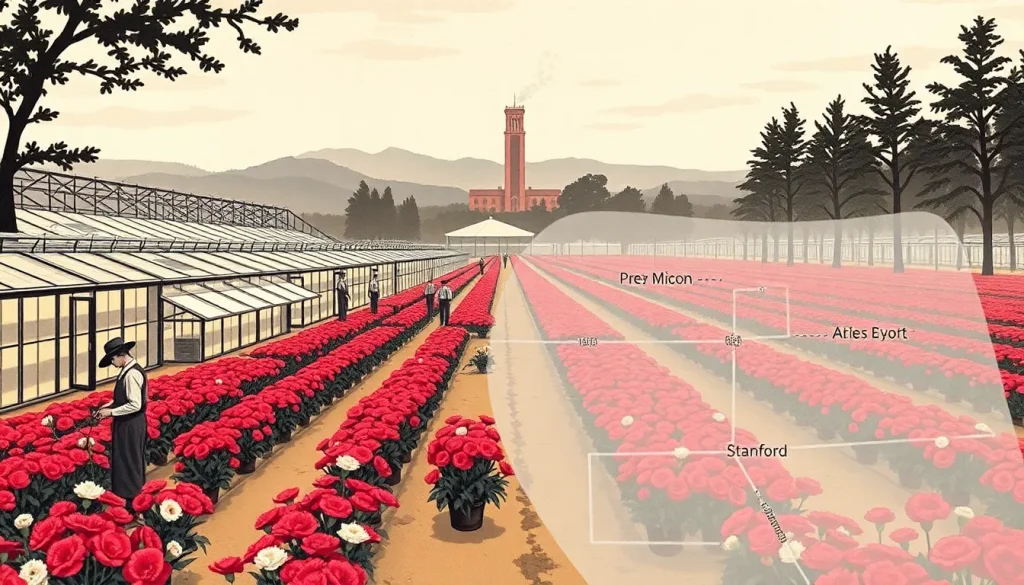
| 1920s | Japanese-operated nurseries and flower farms flourish in the Baylands and along California Avenue, supplying cut flowers to San Francisco markets. |
| February 19, 1942 | Executive Order 9066 authorizes the forced removal of all persons of Japanese ancestry from the West Coast; Palo Alto families are given days to dispose of property. |
| May 1942 | Approximately 200 Palo Alto Japanese Americans are sent to the Santa Anita Assembly Center before being incarcerated at Heart Mountain, Wyoming, and other camps. |
| 1945–1946 | Incarcerated families begin returning to Palo Alto, often finding their homes and businesses occupied or sold. |
| 1948 | The Palo Alto Buddhist Temple is founded at 2751 Louis Road, becoming the spiritual and social heart of the resurgent community. |
| 1960s | Urban redevelopment and the expansion of Stanford Industrial Park displace remaining Japanese American nurseries and residences. |
| 1988 | The Civil Liberties Act grants reparations and a formal apology to surviving internees; local oral history projects begin documenting the community’s story. |
Geographic Setting
The pre-war Japanese American community in Palo Alto was not concentrated in a single, dense ethnic enclave but rather dispersed across several working landscapes. The original nursery lands lay in the low-lying, fertile soils of the Baylands, between present-day East Bayshore Road and the marshes, where Japanese families leased plots to grow chrysanthemums, carnations, and roses. A secondary cluster of Japanese-owned businesses and boarding houses emerged along California Avenue, then known as Mayfield’s commercial spine, and near the Southern Pacific depot. The Buddhist Temple, established after the war at 2751 Louis Road, sits on what was once the edge of these nursery fields. Today, the area is largely overlaid by light industrial parks, the San Antonio Road corridor, and the sprawling Stanford Research Park. What was once a patchwork of glasshouses and family-run flower farms is now buried under asphalt and tilt-up concrete, though the temple remains a living landmark.
Origins
The first Japanese immigrants arrived in the Palo Alto region in the 1890s, part of a larger wave of labor migration from Japan following the Chinese Exclusion Act of 1882. Many were single men from the prefectures of Hiroshima, Kumamoto, and Fukuoka who found work as domestic servants in the homes of Stanford professors or as hands on the large estates of the Peninsula. The exact date of the first permanent Japanese settlement is disputed, with some sources claiming that a small boarding house catering to Japanese workers existed near University Avenue as early as 1895. By 1903, the community was sufficiently established to form the Palo Alto Japanese Association (Palo Alto Nihonjinkai), which organized social events, provided Japanese-language education, and served as a liaison with the white community. The Alien Land Law of 1913, which barred “aliens ineligible for citizenship” from owning land, paradoxically spurred the growth of Japanese-operated nurseries, as families could lease land and invest in movable property like greenhouses. The Issei (first generation) built a network of mutual finance associations, or tanomoshi, to fund their enterprises, circumventing the exclusion from mainstream banks.
Growth and Community Life
By the 1920s, the Japanese American community in Palo Alto and the adjacent town of Mayfield numbered approximately 300 to 400 individuals. The economic backbone was the cut-flower industry; contemporary newspaper accounts reported that the Nishimura, Uyeda, and Sakamoto families operated some of the most productive nurseries in Santa Clara County, shipping carnations as far as Chicago. A Japanese language school, the Palo Alto Gakuen, was established in a rented hall on California Avenue, where Nisei (second generation) children attended classes after public school. Community life revolved around seasonal festivals, baseball leagues, and the annual undokai (sports day) held on rented fields near Stanford. The Japanese Association maintained a community hall that hosted kabuki performances and visiting lecturers from Japan. Despite the thriving cultural life, social tensions simmered; restrictive covenants barred Japanese Americans from purchasing homes in many Palo Alto neighborhoods, and the local chapter of the Native Sons of the Golden West agitated for stricter exclusion laws. Oral histories collected in the 1970s indicate that while daily interactions with white neighbors were often cordial, the threat of racial violence was ever-present, particularly after the 1924 Immigration Act effectively ended Japanese immigration.
Relationship with Nearby Powers
The community’s fate was inextricably linked to Stanford University and the city of Palo Alto. Stanford employed numerous Japanese workers in its dining halls, maintenance crews, and faculty homes, creating a paternalistic but precarious economic dependency. University administrators, including some faculty members, publicly opposed the most virulent anti-Japanese legislation, yet they did little to challenge the restrictive covenants that kept Japanese families out of Professorville. The city of Palo Alto, meanwhile, viewed the Japanese nurseries as both an economic asset and a planning nuisance. As early as the 1930s, city planners eyed the Baylands nursery tracts for industrial development, a vision that would be realized after the war. The political maneuvering of the era is captured in a 1939 city council memo, which noted that “the Japanese flower growers occupy land that will eventually be needed for the expansion of the industrial district,” foreshadowing the dispossession to come.
Annexation, Decline, or Transformation
The transformation of the Japanese American community was not a gradual decline but a violent rupture. On February 19, 1942, Executive Order 9066 set in motion the forced removal of all persons of Japanese ancestry from Military Area No. 1, which included Palo Alto. According to the city inventory of the time, Japanese families were given as little as six days to sell or store their belongings. The Nishimura family, who operated a 10-acre nursery near what is now the intersection of Page Mill Road and El Camino Real, sold their entire operation for $500—a fraction of its value. Most families were first sent to the Santa Anita Assembly Center, where they lived in converted horse stables, before being dispersed to incarceration camps such as Heart Mountain in Wyoming and Tule Lake in California. When the exclusion orders were lifted in 1945, approximately half of the pre-war Japanese American population returned to Palo Alto. They found their homes occupied, their greenhouses dismantled, and their land absorbed into the expanding Stanford Industrial Park. The final meeting of the pre-war Japanese Association was held not in its hall—which had been sold—but in the living room of a sympathetic white neighbor. The community’s physical footprint was erased, but its social fabric was rewoven around the newly founded Palo Alto Buddhist Temple in 1948, which became a sanctuary for returning families and a symbol of resilience.
What Remains Today
The most visible remnant of the Japanese American presence is the Palo Alto Buddhist Temple at 2751 Louis Road. The current building, a modest mid-century structure with a distinctive curved roof, should not be confused with the original pre-war community hall, which stood on California Avenue and was demolished in the 1950s. The temple’s interior houses a butsudan (altar) and memorial plaques bearing the names of Issei pioneers. A small garden with a stone lantern, dedicated in 1998, commemorates the centennial of the first Japanese immigrants. A few blocks away, at the corner of California Avenue and Birch Street, a single surviving warehouse once used by the Sakamoto nursery now houses a coffee shop; its exposed timber trusses are the only architectural clue to its agricultural past. No known photographs of the original Japanese language school survive, but a bronze plaque installed in 2005 at the site of the former community hall on California Avenue marks the location. The city’s official historic inventory lists only one property associated with Japanese American history: the temple itself, a designation that advocates argue is woefully incomplete.
Historical Photographs and Maps
A 1926 Sanborn fire insurance map, held at the Palo Alto Historical Association, shows the cluster of glasshouses and packing sheds operated by the Uyeda family along what was then a dirt lane, now subsumed by East Bayshore Road. The map reveals the intricate layout of boiler rooms, cold frames, and irrigation ditches that sustained year-round flower production. A series of photographs taken by Stanford sociology professor Yamato Ichihashi in the 1930s, now in the Hoover Institution Archives, documents daily life in the community: children in kimono at the undokai, workers grading carnations, and the interior of the Japanese language school. The most haunting visual record is a set of 1942 photographs by Dorothea Lange, commissioned by the War Relocation Authority, which captured the Nishimura family packing their belongings on a Palo Alto street corner. These images, though staged, convey the abruptness of the removal. No comprehensive map of pre-war Japanese-owned properties exists, but a 1940 land-use survey by the city planning department, annotated with the names of lessees, provides a partial reconstruction.
Historiographical Notes
The story of Palo Alto’s Japanese American community has been told in fragments, often overshadowed by the larger narratives of San Jose’s Japantown or San Francisco’s Nihonmachi. Early county histories, such as the 1922 History of Santa Clara County by Eugene T. Sawyer, mention the Japanese presence only in passing, typically as “industrious gardeners” and rarely by name. The official city histories produced for Palo Alto’s centennial in 1994 devote a single paragraph to the community, framing the internment as an unfortunate but necessary wartime measure—a framing that has since been challenged by scholars. Revisionist work began in earnest in the 1980s, driven by the oral history projects of the Japanese American Citizens League and the Palo Alto Historical Association. The 2003 publication Blossoms in the Dust: The Japanese American Experience in Palo Alto by historian Michiko Tanaka remains the most comprehensive account, drawing on camp newspapers, property records, and interviews with surviving Nisei. Tanaka’s work reveals that the dispossession of Japanese American property was not merely a byproduct of war hysteria but was actively facilitated by local real estate interests and city officials who had long coveted the nursery lands for industrial expansion.
Sources and Archives
The richest repository of primary sources is the Palo Alto Historical Association, which holds the records of the Palo Alto Japanese Association (1903–1942), including membership rolls, financial ledgers, and correspondence with city officials. The Japanese American Museum of San Jose maintains an extensive oral history collection, with over 30 interviews of Palo Alto Nisei conducted between 1985 and 2005. Stanford University’s Department of Special Collections houses the Yamato Ichihashi papers, which include field notes and photographs from his 1930s sociological study of the community. The National Archives at San Francisco holds the individual case files of Palo Alto internees, as well as the War Relocation Authority’s property disposal records. The Palo Alto Buddhist Temple’s own archive, though uncatalogued, contains pre-war photographs, temple board minutes, and the original 1948 articles of incorporation. Researchers should also consult the Palo Alto Times (digitized from 1893 to 1950) for contemporary newspaper coverage, though it must be read critically for its often condescending tone.
Related People and Places
Kazuo Uyeda (1890–1972): Issei nurseryman who founded Uyeda Brothers Nursery in 1918, one of the largest cut-flower operations in the Bay Area. Incarcerated at Heart Mountain, he returned to find his greenhouses dismantled and spent his later years as a gardener for Stanford University. His son, George Uyeda, became the first Nisei president of the Palo Alto Buddhist Temple board.
Yamato Ichihashi (1878–1963): Stanford professor of Japanese history and one of the first scholars to document the Japanese American experience. His 1932 study Japanese in the United States includes detailed observations of the Palo Alto community. Ichihashi himself was incarcerated at Tule Lake, a bitter irony that colored his later writings.
Michiko Tanaka (b. 1952): Sansei historian and author of Blossoms in the Dust, whose work recovered the lost geography of the pre-war nurseries and challenged the official narrative of benign wartime removal.
San Jose Japantown: The nearest major Japanese American enclave, located 15 miles south, which served as a cultural and economic hub for Peninsula families. Many Palo Alto Nisei attended the San Jose Buddhist Church and participated in its sports leagues.
Heart Mountain Relocation Center: The Wyoming incarceration camp where the majority of Palo Alto’s Japanese American families were held. The camp’s newspaper, the Heart Mountain Sentinel, frequently published letters from Palo Alto internees, providing a rare window into their experiences.
Stanford Industrial Park: The 700-acre research park, established in 1951 on land that had been Japanese American nursery tracts, symbolizes the erasure of the community’s agricultural past and its replacement by the high-tech economy that defines modern Palo Alto.
FAQ
Was there a Japantown in Palo Alto?
No, Palo Alto never had a dense, contiguous Japantown like San Jose or San Francisco. The Japanese American community was dispersed among nurseries in the Baylands and a small cluster of businesses along California Avenue.
What happened to the Japanese-owned nurseries during World War II?
Most were sold under duress for a fraction of their value or simply abandoned. After the war, the land was acquired for the Stanford Industrial Park and other developments, erasing nearly all physical traces.
Where can I see remnants of this history today?
The Palo Alto Buddhist Temple at 2751 Louis Road is the primary surviving institution. A bronze plaque on California Avenue marks the site of the former Japanese community hall, and a former nursery warehouse now houses a coffee shop at California and Birch.
How many Japanese Americans from Palo Alto were incarcerated?
Approximately 200 individuals from Palo Alto and the surrounding area were forcibly removed and incarcerated, primarily at Heart Mountain, Wyoming.
Leave a Reply