Short Answer
Location
Palo Alto City Hall is prominently situated at 250 Hamilton Avenue, in the heart of downtown Palo Alto, California. The building occupies a full city block bounded by Hamilton Avenue, Bryant Street, Ramona Street, and Forest Avenue. Its location places it at the civic and cultural nexus of the city, directly across from the Rinconada Cultural Center and within walking distance of the Palo Alto Art Center, the Junior Museum and Zoo, and the historic downtown commercial district. The site is approximately 2 miles southeast of Stanford University and 35 miles south of San Francisco, easily accessible via U.S. Route 101 and Caltrain’s Palo Alto Station.
Why It Is Significant
Palo Alto City Hall is far more than an administrative building; it is a tangible expression of the city’s identity, a repository of public art, and a rare surviving example of a Works Progress Administration (WPA) civic project that remains in its original use. The building is significant for its exceptional Spanish Colonial Revival architecture, which deliberately echoes the nearby Stanford University campus and symbolizes Palo Alto’s deep ties to the institution. Its interior features a monumental mural by Millard Sheets, one of California’s most important 20th-century artists, depicting the region’s history. Listed on the National Register of Historic Places, the City Hall embodies the optimism and public investment of the New Deal era while continuing to function as the seat of local government, hosting city council meetings, public ceremonies, and civic discourse.
Historical Timeline
| Year | Event |
|---|---|
| 1894 | Palo Alto incorporates as a city; early council meetings held in rented halls and a modest frame building on University Avenue. |
| 1936 | Voters approve a bond measure to construct a permanent City Hall, reflecting the city’s growth and ambition. |
| 1937–1938 | Construction of the new City Hall under architect Charles K. Sumner, funded in part by the Public Works Administration (PWA). |
| 1938 | City Hall dedicated; Millard Sheets’ mural “The History of Palo Alto” installed in the lobby. |
| 1985 | Building listed on the National Register of Historic Places as a contributing property to the Palo Alto Civic Center Historic District. |
| 2000s | Seismic retrofitting and interior renovations completed to modernize facilities while preserving historic fabric. |
| 2018 | 80th anniversary celebrated with public exhibitions and restoration of the Sheets mural. |
Architectural or Natural Characteristics
Spanish Colonial Revival Style
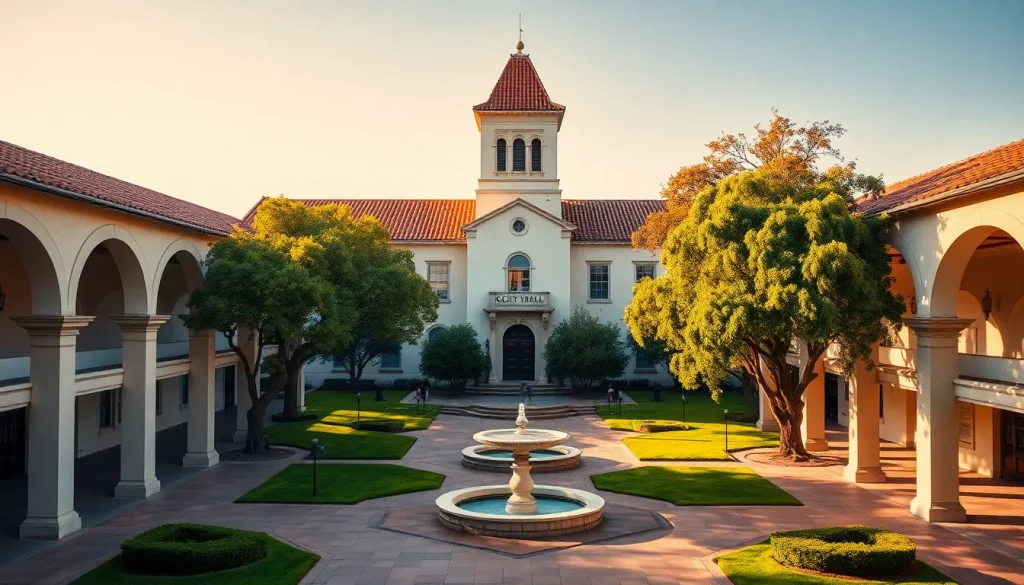
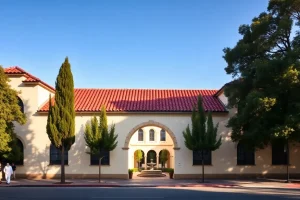
Palo Alto City Hall is a distinguished example of the Spanish Colonial Revival style, an architectural movement that romanticized California’s Hispanic heritage. The building’s low-slung, horizontal massing, red clay tile roof, and smooth stucco walls evoke the missions and ranchos of early California. Its most prominent feature is the central bell tower, which rises above the main entrance and is capped with a domed cupola and a wrought-iron cross. The tower houses a set of chimes that ring out over the Civic Center Plaza. Arcaded walkways with rounded arches and decorative ironwork line the interior courtyard, providing shaded passage and a sense of cloistered tranquility.
Interior and the Millard Sheets Mural
The lobby’s focal point is a 75-foot-long fresco mural by Millard Sheets, a leading figure in the California Scene Painting movement. Completed in 1938, the mural depicts the history of Palo Alto from the indigenous Ohlone people and Spanish missionaries to the rise of Stanford University and the early technology ventures that would later define Silicon Valley. Sheets employed vibrant colors and dynamic compositions, integrating local flora and architectural landmarks. The mural was restored in 2018, reviving its original luminosity. The interior also features hand-painted ceiling beams, wrought-iron chandeliers, and decorative tile work that reinforce the Spanish Colonial aesthetic.
Civic Center Plaza and Landscape
The building is set within a landscaped Civic Center Plaza, originally designed by landscape architect Leslie Kiler. Mature coast live oaks and Canary Island date palms frame the building, while a central fountain and formal gardens create a dignified public gathering space. The plaza serves as a forecourt to the City Hall and connects visually to the adjacent Rinconada Cultural Center, forming a unified civic campus.
Cultural Meaning
Palo Alto City Hall stands as a symbol of the city’s transition from a small college town to a self-assured municipality. Its construction during the Great Depression, supported by federal New Deal programs, represents a collective investment in democratic institutions and public beauty. The building’s architectural dialogue with Stanford University—echoing the campus’s sandstone arcades and red-tiled roofs—reinforces the inseparable bond between town and gown. The Sheets mural functions as a visual civic narrative, reminding residents and visitors of the layered history beneath Silicon Valley’s tech-centric surface. Today, City Hall is not only a working government building but also a site of community memory, protest, celebration, and everyday democratic participation.
Visiting Information
- Address: 250 Hamilton Avenue, Palo Alto, CA 94301
- Hours: City Hall is open to the public Monday through Friday, 8:00 AM to 5:00 PM, excluding city holidays. The lobby and mural are accessible during these hours. The exterior plaza is open daily.
- Admission: Free.
- Guided Tours: Docent-led tours of the building and mural are offered periodically through the Palo Alto Historical Association. Self-guided walking tour brochures are available at the City Clerk’s office.
- Parking: Limited metered street parking is available on surrounding blocks. The nearest public garage is at 520 Webster Street.
- Public Transit: Caltrain’s Palo Alto Station is a 15-minute walk. VTA bus routes 22 and 522 stop nearby on El Camino Real.
Accessibility
The building is fully accessible to visitors with disabilities. Ramps and automatic doors are located at the main Hamilton Avenue entrance and the rear parking lot entrance. An elevator provides access to all public floors. Accessible restrooms are available on the ground floor. Assistive listening devices are available for City Council meetings in the Council Chambers. Service animals are welcome. For specific accommodations, contact the City Clerk’s office at least 48 hours in advance.
Preservation Status
Palo Alto City Hall is a designated contributing property to the Palo Alto Civic Center Historic District, listed on the National Register of Historic Places since 1985. It is also protected under Palo Alto’s Historic Preservation Ordinance. The building underwent a comprehensive seismic retrofit and rehabilitation in the early 2000s, which upgraded structural systems, HVAC, and accessibility while meticulously preserving character-defining features such as the stucco exterior, tile roof, ironwork, and interior finishes. The Millard Sheets mural received a professional conservation treatment in 2018 funded by the city and private donations. Ongoing maintenance is managed by the Public Works Department, with periodic condition assessments to ensure the landmark’s integrity for future generations.
Common Misconceptions
The building was designed by Stanford’s architects.
Reality: While the style echoes Stanford’s early buildings, the architect was Charles K. Sumner, a prominent local practitioner, not the university’s architects.
The mural is a WPA Federal Art Project work.
Reality: Millard Sheets was commissioned directly by the city with PWA funds, not through the WPA’s art programs, though the building itself was a PWA project.
The bell tower is purely decorative.
Reality: The tower houses a working set of chimes that are still played on special occasions.
Map
FAQ
Can I visit the Millard Sheets mural without a tour?
Yes, the mural is located in the main lobby of City Hall, which is open to the public during regular business hours (Monday–Friday, 8 AM–5 PM). No appointment is necessary to view it.
Is photography allowed inside City Hall?
Non-flash photography for personal use is generally permitted in the public areas, including the lobby and mural. Tripods and commercial photography may require a permit from the City Clerk's office.
Are City Council meetings open to the public?
Yes, all regular City Council meetings are open to the public and held in the Council Chambers within City Hall. Schedules and agendas are posted on the city's official website.
Does the bell tower still ring?
The tower houses a set of chimes that are played on special occasions, such as city anniversaries and holidays. They are not rung on a daily schedule.
Is the building available for private events or weddings?
Certain spaces, such as the courtyard and lobby, may be available for rental for private events. Inquiries should be directed to the City's Facilities Rental office for availability and fees.

Leave a Reply