Short Answer
Location
The Stanford Theatre is located at 221 University Avenue in downtown Palo Alto, California, within the San Francisco Bay Area. It occupies a prominent corner at the intersection of University Avenue and Emerson Street, placing it at the heart of the city’s commercial and cultural district. The theatre is approximately two miles from the Stanford University campus, with which it shares a historical and cultural affinity, though it is independently operated. Its central location makes it easily accessible by car, public transit, and on foot, anchoring a vibrant streetscape of restaurants, bookstores, and shops.
Why It Is Significant
The Stanford Theatre is far more than a vintage cinema; it is a temple of film preservation and a time capsule of the golden age of Hollywood. Unlike most historic theatres that have been subdivided into multiplexes or converted to live performance venues, the Stanford remains a single-screen movie palace dedicated exclusively to the exhibition of classic films. Its significance rests on three pillars: architectural integrity, curatorial mission, and technological authenticity. The theatre shows films exclusively on 35mm and nitrate stock, often struck from original negatives, and accompanies many screenings with live music from its original 1925 Wurlitzer pipe organ. Under the stewardship of the David and Lucile Packard Foundation, the Stanford Theatre has become an internationally recognized center for the study and appreciation of early and mid-20th-century cinema, drawing scholars, cinephiles, and tourists from around the globe.
Historical Timeline
| Year | Event |
|---|---|
| 1925 | The Stanford Theatre opens on June 9 as a vaudeville and silent film house, designed by architect W. H. Weeks. The opening program features the silent film The Freshman with Harold Lloyd. |
| 1928 | Installation of the Wurlitzer Hope-Jones Unit Orchestra pipe organ, opus 1724, to accompany silent films and stage shows. |
| 1930s–1950s | The theatre thrives as a first-run movie palace, showcasing Hollywood’s biggest stars and productions. It becomes a beloved community gathering place. |
| 1960s–1970s | Decline sets in as television and multiplexes draw audiences away. The theatre struggles with dwindling attendance and deferred maintenance. |
| 1987 | The Stanford Theatre closes its doors, facing an uncertain future and possible demolition or conversion. |
| 1989 | After a two-year, painstaking restoration funded by the David and Lucile Packard Foundation, the theatre reopens on September 29 as a repertory cinema dedicated to classic Hollywood films. |
| 1990s–Present | The theatre gains international acclaim for its programming, nitrate film screenings, and scholarly approach. It continues to operate as a non-profit cultural institution. |
Architectural or Natural Characteristics
Exterior Design
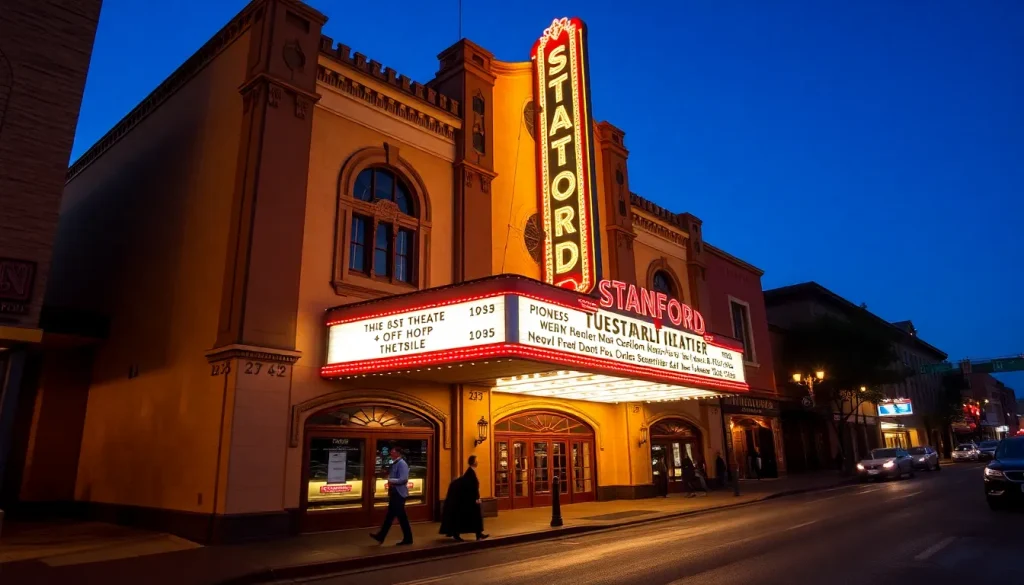
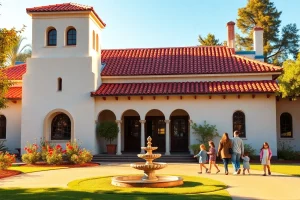
The Stanford Theatre is a distinguished example of Spanish Colonial Revival architecture, a style popular in California during the 1920s. The façade is characterized by a stucco finish, red clay tile roofing, ornate Churrigueresque detailing, and a prominent marquee that glows with neon at night. The vertical sign spelling “STANFORD” in classic lettering is a landmark of the University Avenue streetscape. The building’s asymmetrical massing, arched windows, and decorative ironwork evoke the romanticism of early California missions and haciendas, while the marquee and blade sign firmly anchor it in the era of the movie palace.
Interior Splendor
Inside, the theatre transports visitors to a lavish 1920s dreamscape. The auditorium seats approximately 1,400 patrons under a ceiling painted to resemble a twilight sky with twinkling stars and drifting clouds—a hallmark of the atmospheric theatre style. The proscenium arch is framed by elaborate plasterwork featuring gilded filigree, heraldic shields, and sculpted figures. The side walls are adorned with mock balconies, columns, and niches, creating the illusion of a Spanish courtyard. The original Wurlitzer organ console rises from the orchestra pit on a hydraulic lift, its pipes concealed behind decorative grilles. Every surface, from the carpeting to the light fixtures, was meticulously restored or replicated to match the 1925 original.
Projection Technology
The projection booth houses a rare collection of 35mm and nitrate film projectors, maintained to museum standards. The theatre is one of the few venues in the world licensed to project nitrate film, the highly flammable but visually luminous stock used before the 1950s. This commitment to authentic presentation extends to the screen’s aspect ratio, which can be adjusted to accommodate the original dimensions of silent films, early talkies, and widescreen epics.
Cultural Meaning
The Stanford Theatre occupies a unique place in American cultural life. It is not merely a venue for nostalgia but an active educational institution that frames classic cinema as a vital art form. By screening films in their original formats and often with live musical accompaniment, the theatre recreates the experience of moviegoing as it existed in the first half of the 20th century. This immersive approach fosters a deeper understanding of film history, directorial intent, and the evolution of visual storytelling. For the city of Palo Alto and the broader Bay Area, the theatre is a cherished civic landmark that embodies a commitment to preservation, artistry, and community. It has also become a pilgrimage site for film lovers worldwide, who come to see rare prints and experience the magic of a true movie palace.
Visiting Information
Hours of Operation
- The theatre typically screens films Thursday through Sunday, with occasional weekday evening shows.
- Box office opens one hour before the first screening of the day.
- Schedule varies; check the official website for current showtimes.
Admission
- Tickets are sold exclusively at the box office on the day of the show; no online or advance sales.
- General admission: $7.00 (subject to change).
- Double features are common, with one ticket granting access to both films.
Guidelines
- No late seating once the film has begun.
- Photography and recording devices are strictly prohibited.
- The theatre is not available for private rentals or events.
Accessibility
The Stanford Theatre, as a historic building, presents some accessibility challenges. The main entrance on University Avenue has a few steps, but a wheelchair-accessible entrance is available via the adjacent alley. Once inside, accessible seating is provided on the main floor. Assistive listening devices are available upon request. Restrooms are located on the main level but are not fully ADA-compliant due to the building’s age. Visitors with specific needs are encouraged to contact the theatre in advance to ensure a comfortable experience. The theatre staff is known for being accommodating within the constraints of the historic structure.
Preservation Status
The Stanford Theatre is listed on the National Register of Historic Places and is a designated Palo Alto Historic Landmark. The 1987–1989 restoration, led by the David and Lucile Packard Foundation, was a comprehensive effort that returned the building to its 1925 appearance while discreetly upgrading mechanical, electrical, and safety systems. The foundation continues to fund ongoing maintenance and conservation, ensuring that the theatre’s architectural fabric and technical equipment remain in pristine condition. The projection equipment is regularly serviced by specialists, and the Wurlitzer organ receives expert care. The theatre’s preservation model—combining private philanthropy with a clear curatorial mission—is widely regarded as a benchmark for historic cinema conservation.
Common Misconceptions
Map
FAQ
What kind of films does the Stanford Theatre show?
The theatre exclusively screens classic Hollywood films, primarily from the 1920s through the 1960s, including silent films, musicals, film noir, and widescreen epics. All films are shown on 35mm or nitrate stock.
Is the Stanford Theatre part of Stanford University?
No. Despite its name, the theatre is independently operated by the non-profit Stanford Theatre Foundation and has no formal affiliation with Stanford University.
Can I buy tickets online or in advance?
No. Tickets are sold only at the box office on the day of the screening, starting one hour before the first show. This policy helps maintain the theatre’s historic character and community atmosphere.
Is there a live organ performance before the film?
Yes, many evening screenings are preceded by a live performance on the theatre’s original 1925 Wurlitzer pipe organ, played by a rotating roster of accomplished organists.
Is the theatre available for private events or rentals?
No, the Stanford Theatre is not available for private rentals. It operates solely as a public cinema dedicated to classic film exhibition.

Leave a Reply