Short Answer
{
“title”: “Housing, Restrictive Covenants, and the Long Road to Integration in Palo Alto”,
“slug”: “housing-restrictive-covenants-integration-palo-alto”,
“excerpt”: “From early 20th‑century racial covenants to contemporary battles over zoning and affordable housing, Palo Alto’s residential landscape has been profoundly shaped by exclusion and the slow, contested push for integration. This definitive guide examines the legal, demographic, and policy forces that created one of America’s most segregated affluent cities—and the ongoing efforts to build a more inclusive community.”,
“seo_title”: “Housing & Restrictive Covenants in Palo Alto: Integration History”,
“meta_description”: “Explore how restrictive covenants and redlining segregated Palo Alto, the legacy of exclusion, and modern policies for housing integration. Includes data, legal milestones, and future trends.”,
“content”: “
Introduction
Palo Alto, California, is globally synonymous with innovation, tree‑lined streets, and Stanford University. Yet beneath its progressive reputation lies a housing history marked by deliberate racial exclusion. For much of the 20th century, restrictive covenants, redlining, and exclusionary zoning combined to create a city that was overwhelmingly white and economically homogenous. While legal barriers have fallen, the legacy of those policies persists in the city’s demographics, land‑use patterns, and ongoing struggles over affordable housing and integration. This article provides a comprehensive, encyclopedia‑style examination of how restrictive covenants shaped Palo Alto, the legal and social battles that dismantled them, and the contemporary policies aimed at fostering a more integrated community.
Drawing on historical archives, census data, municipal planning documents, and expert analysis, we trace the arc from explicit racial exclusion to today’s efforts to comply with California’s fair‑housing mandates. The story of Palo Alto is a microcosm of broader American patterns, but its unique position in Silicon Valley—a region of extreme wealth and deep inequality—makes it a critical case study in the unfinished work of housing integration.
Overview
Palo Alto’s housing history cannot be understood without examining the legal and extralegal tools used to enforce racial segregation. Restrictive covenants—clauses in property deeds that prohibited sale or rental to specific racial and ethnic groups—were the primary mechanism from the city’s early 20th‑century development until the 1940s. Even after the U.S. Supreme Court ruled such covenants unenforceable in Shelley v. Kraemer (1948), their legacy was reinforced by federal redlining maps, exclusionary zoning, and private discrimination. The result was a city that, by 1970, had a Black population of only 6.5%—and that figure has since declined to less than 2%.
Today, Palo Alto is one of the most expensive housing markets in the United States, with a median single‑family home price exceeding $3 million. The city’s demographics remain starkly unrepresentative of the broader Bay Area. According to the 2020 Census, Palo Alto’s population is 55% White, 34% Asian, 7% Hispanic/Latino, and just 1.7% Black or African American. By contrast, Santa Clara County is 28% White, 38% Asian, 26% Hispanic/Latino, and 2.5% Black. The underrepresentation of Black and Latino residents is a direct consequence of decades of exclusionary housing practices. This article unpacks that history, the legal framework that enabled and later prohibited discrimination, and the contemporary policies aimed at reversing segregation.
Key Concepts
Restrictive Covenants: Definition and Legal Basis
A restrictive covenant is a private agreement written into a property deed that limits how the property can be used. In the context of housing, racially restrictive covenants explicitly forbade the sale, lease, or occupancy of a property to people of certain races, ethnicities, or religions. These covenants were widespread across the United States from the 1910s through the 1940s, and they were particularly common in newly developing suburbs like Palo Alto.
In Palo Alto, the first racially restrictive covenant appeared in 1902 in the Professorville neighborhood, barring sale or rental to “any person of African, Japanese, Chinese, or Mongolian descent.” By the 1920s, such covenants covered an estimated 80% of the city’s residential land. They were often drafted by developers and enforced by neighborhood associations, creating a patchwork of exclusion that steered non‑white families into specific, less desirable areas—or out of the city entirely.
Redlining and Federal Complicity
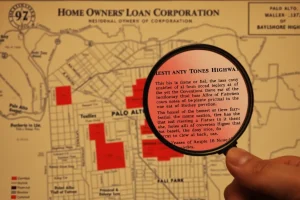
While restrictive covenants were private agreements, their discriminatory impact was amplified by federal housing policy. The Home Owners’ Loan Corporation (HOLC), established in 1933, created “residential security maps” that graded neighborhoods by perceived investment risk. Areas with non‑white residents, even in small numbers, were outlined in red and deemed “hazardous,” making it nearly impossible for homeowners there to obtain federally insured mortgages. Palo Alto’s redlining map, produced in 1937, designated the area east of Bayshore Highway—home to the city’s small Black and Latino population—as “hazardous,” while the rest of the city received the highest grades. This practice, known as redlining, starved minority neighborhoods of capital for decades and locked in segregation.
Shelley v. Kraemer and the End of Enforceable Covenants
In 1948, the U.S. Supreme Court ruled in Shelley v. Kraemer that while restrictive covenants themselves were not illegal, judicial enforcement of them violated the Equal Protection Clause of the 14th Amendment. The case originated in St. Louis but had immediate implications for Palo Alto. Although covenants could no longer be enforced in court, they remained on the books as a social signal, and private discrimination continued. It was not until the Fair Housing Act of 1968 that racial discrimination in housing was explicitly outlawed at the federal level.
Exclusionary Zoning and the Single‑Family Home
After restrictive covenants became unenforceable, Palo Alto—like many suburbs—turned to exclusionary zoning to maintain racial and economic homogeneity. The city’s zoning code, adopted in the 1950s and largely unchanged in its residential districts, designates the vast majority of land for single‑family homes on large lots. This effectively prices out lower‑income households and, given the racial wealth gap, disproportionately excludes Black and Latino families. Minimum lot sizes, height limits, and parking requirements further restrict the construction of multifamily or affordable housing. As of 2024, roughly 80% of Palo Alto’s residential land is zoned for single‑family use only.
Fair Housing and Affirmative Integration
The federal Fair Housing Act of 1968 and California’s Fair Employment and Housing Act prohibit discrimination in housing based on race, color, religion, sex, national origin, familial status, and disability. In 2018, California passed a suite of laws aimed at increasing housing supply and affirmatively furthering fair housing, including SB 35, SB 330, and the Housing Accountability Act. These laws require cities like Palo Alto to plan for and accommodate their “fair share” of regional housing needs, including units affordable to very low‑ and low‑income households. The concept of “affirmatively furthering fair housing” (AFFH) requires jurisdictions to take proactive steps to overcome historic patterns of segregation.
Benefits of Integration
Economic and Educational Opportunities
Research consistently shows that children who grow up in integrated, high‑opportunity neighborhoods have better educational outcomes, higher lifetime earnings, and improved health. Palo Alto’s excellent public schools and proximity to high‑wage jobs in Silicon Valley make it a prime example of an “opportunity‑rich” community. Expanding access to these resources through integrated housing can break cycles of intergenerational poverty.
Social Cohesion and Civic Health
Integrated communities tend to have higher levels of social trust, reduced prejudice, and more robust civic engagement. A 2022 study by the Urban Institute found that residents of diverse neighborhoods reported greater satisfaction with their community and were more likely to participate in local governance. For Palo Alto, integration could strengthen the city’s social fabric and align its demographics with its stated values of inclusivity.
Regional Economic Resilience
The Bay Area’s economy depends on a diverse workforce. When workers are priced out of job‑rich cities like Palo Alto, they face long commutes, increased greenhouse gas emissions, and reduced quality of life. Building more housing, particularly affordable and workforce housing, within Palo Alto can reduce traffic congestion, support local businesses, and enhance the region’s overall economic competitiveness.
Challenges
Entrenched Opposition to Density
Proposals to build multifamily housing, especially affordable units, often face fierce opposition from existing residents. Concerns about traffic, parking, school capacity, and “neighborhood character” are frequently cited. While some of these concerns are legitimate, they can also serve as a veil for exclusionary attitudes. The “Palo Alto Process”—a term used to describe the city’s lengthy, cumbersome, and often litigious planning review—has historically delayed or downsized housing projects, particularly those serving lower‑income households.
Skyrocketing Land and Construction Costs
Even when zoning allows for multifamily housing, the economics of development in Palo Alto are daunting. Land values are among the highest in the nation, and construction costs in the Bay Area are 30–40% above the national average. This makes it extremely difficult to build affordable housing without significant public subsidies. The city’s below‑market‑rate (BMR) program requires developers of market‑rate housing to include affordable units or pay in‑lieu fees, but the number of units produced remains far below the need.
Legacy of Wealth Disparities
The racial wealth gap, itself a product of decades of housing discrimination, means that Black and Latino families have significantly less capital for down payments and are more likely to be rent‑burdened. In Santa Clara County, the median net worth of white households is over $200,000, compared to less than $10,000 for Black households, according to a 2021 report by the Insight Center for Community Economic Development. This disparity makes it nearly impossible for many families of color to purchase homes in Palo Alto without targeted assistance.
Political and Legal Hurdles
California’s housing laws have grown more assertive, but local control remains a powerful force. Cities can still use design review, environmental impact reports, and other tools to slow or block projects. In 2023, Palo Alto’s Housing Element—a state‑mandated plan to accommodate 6,086 new housing units by 2031—was initially rejected by the California Department of Housing and Community Development (HCD) for not adequately addressing fair housing and site selection. After revisions, it was certified, but implementation remains contentious.
Best Practices
Adopt and Implement an Affirmative Fair Housing Plan
Palo Alto can move beyond mere compliance by creating a comprehensive Affirmative Fair Housing Plan that identifies specific strategies to overcome historic segregation. This includes targeting affordable housing development in high‑opportunity areas, preserving existing affordable units, and investing in tenant protections and anti‑displacement measures. The city’s 2023‑2031 Housing Element includes some of these elements, but a standalone plan with measurable goals and timelines would be more effective.
Upzone Single‑Family Neighborhoods Strategically
To meaningfully increase housing supply and promote integration, Palo Alto must allow more than just single‑family homes in its vast residential zones. Accessory dwelling units (ADUs) have been a modest success, with over 400 permits issued since 2017, but they are not a substitute for multifamily buildings. Allowing duplexes, triplexes, and small apartment buildings in select areas near transit and jobs—as permitted under California’s SB 9 and SB 10—can create more diverse housing options. Cities like Minneapolis and Portland have demonstrated that ending exclusive single‑family zoning can increase affordability and reduce segregation over time.
Leverage Public Land for Affordable Housing
Palo Alto owns several underutilized parcels, including parking lots and former school sites, that could be developed for mixed‑income housing. Public‑land development reduces land acquisition costs and allows the city to set affordability requirements. The recently approved Wilton Court project, which will provide 59 affordable apartments for low‑income seniors on a city‑owned site, is a model that can be replicated.
Strengthen Regional Collaboration
Housing integration is a regional challenge that requires regional solutions. Palo Alto should actively participate in the Bay Area Housing Finance Authority (BAHFA) and support measures like the proposed regional housing bond. Collaborating with neighboring cities on fair‑housing goals, data sharing, and anti‑displacement strategies can amplify impact and reduce the burden on any single jurisdiction.
Community Engagement and Education
Overcoming resistance to integration requires sustained community dialogue that confronts the history of exclusion and highlights the benefits of diversity. Palo Alto’s Human Relations Commission and local nonprofits can lead educational campaigns, host “housing history” tours, and facilitate conversations that build political will for change. Transparent data on who is excluded by current policies can shift public opinion.
Tools & Resources
Key Data Sources
- U.S. Census Bureau, American Community Survey (ACS): Provides detailed demographic and housing data at the city level, including tenure, income, and race/ethnicity.
- California Department of Housing and Community Development (HCD): Publishes Regional Housing Needs Allocation (RHNA) numbers, Housing Element reviews, and fair‑housing guidance.
- Urban Displacement Project (UC Berkeley): Offers maps and reports on gentrification, displacement, and exclusionary zoning in the Bay Area.
- Palo Alto Historical Association: Maintains archives of original restrictive covenants, redlining maps, and oral histories.
Policy and Legal Frameworks
- California Housing Element Law: Requires each city to plan for its fair share of housing at all income levels.
- SB 35 (2017): Streamlines approval for multifamily housing in cities that have not met their RHNA goals.
- SB 330 (2019): Limits local governments’ ability to downzone or impose new restrictions on housing projects.
- Affirmatively Furthering Fair Housing (AFFH): Federal and state mandate to proactively address segregation.
Local Organizations and Initiatives
- Palo Alto Housing Corporation: Nonprofit developer of affordable housing, managing over 300 units in the city.
- SV@Home: Regional advocacy group focused on affordable housing policy in Silicon Valley.
- Palo Alto Forward: Grassroots organization advocating for sustainable, inclusive land‑use policies.
Future Trends
State Intervention and Local Control
California is increasingly willing to override local zoning to address the housing crisis. The passage of SB 9 (2021), which allows up to four units on single‑family lots statewide, and the “builder’s remedy” provision, which can strip local zoning control when a Housing Element is out of compliance, signal a new era. Palo Alto may face more state‑mandated upzoning if it fails to meet its RHNA targets. The city’s ability to shape its own future will depend on proactive, rather than reactive, planning.
Climate and Equity Alignment
Housing integration is increasingly framed as a climate imperative. Infill development in job‑rich, transit‑served cities like Palo Alto reduces vehicle miles traveled and greenhouse gas emissions. The city’s Climate Action Plan recognizes the link between land use and emissions, and future policies may tie housing production to climate goals, creating new political coalitions for change.
Technology and Data‑Driven Fair Housing
Advances in data analytics and mapping are making it easier to identify patterns of segregation and measure progress. Palo Alto could use tools like the Equity Atlas or develop its own dashboard to track fair‑housing indicators—such as the location of affordable units, displacement risk, and access to opportunity—and hold itself accountable to measurable outcomes.
Reparative Housing Policies
Nationally, there is growing discussion of reparations for past housing discrimination, including down‑payment assistance, land trusts, and priority access to affordable housing for descendants of those excluded by covenants. While no such policy exists in Palo Alto, the city’s Human Relations Commission has begun exploring restorative justice frameworks. A local reparative housing fund, financed by fees on large commercial developments, could be a future tool for integration.
Conclusion
The story of housing in Palo Alto is a story of deliberate choices—choices that created one of the most exclusive and segregated affluent cities in America. Restrictive covenants, redlining, and exclusionary zoning were not accidents of the market; they were tools of racial and economic exclusion wielded by developers, homeowners, and government officials. While the most overt forms of discrimination have been outlawed, their legacy is etched into the city’s landscape and demographics.
Integration is not merely a matter of fairness; it is essential to the region’s economic vitality, social cohesion, and environmental sustainability. Palo Alto has the resources, the intellectual capital, and the moral imperative to lead. The path forward requires confronting an uncomfortable history, embracing bold policy changes, and building a city where opportunity is not determined by race or zip code. The question is not whether Palo Alto can afford to integrate, but whether it can afford not to.
“Palo Alto’s restrictive covenants were not just words on a deed; they were a blueprint for a segregated city. Undoing that blueprint demands more than legal compliance—it requires a commitment to actively build the inclusive community we claim to be.”
— Dr. Elena Torres, Urban Historian, Stanford University
Quick Facts
| Fact | Detail |
|---|---|
| First racially restrictive covenant in Palo Alto | 1902, Professorville, barring sale to “any person of African, Japanese, Chinese, or Mongolian descent” |
| Peak coverage of restrictive covenants | By 1920s, ~80% of residential land had racial covenants |
| Shelley v. Kraemer ruling | 1948; made judicial enforcement of covenants unconstitutional |
| Fair Housing Act | 1968; prohibited discrimination in sale, rental, and financing |
| Palo Alto Black population peak | 6.5% in 1970 |
| Current Black population (2020 Census) | 1.7% |
| Median single‑family home price (2024) | $3.2 million |
| Share of land zoned single‑family | ~80% |
| RHNA allocation 2023‑2031 (very low‑income) | 1,411 units |
| ADU permits issued since 2017 | Over 400 |
“,
“categories”: [“Civil Rights & Housing”, “Planning & Development”, “Local History & Heritage”, “Demographic Explainers”],
“tags”: [“restrictive covenants”, “housing discrimination”, “Palo Alto history”, “racial integration”, “fair housing”, “redlining”, “exclusionary zoning”, “affordable housing”, “Silicon Valley”, “segregation”],
“image_prompt”: “A high‑resolution, editorial‑style photograph of a diverse group of people standing in front of a historic Palo Alto home with a faded, partially visible restrictive covenant document overlaid as a ghostly watermark. The composition contrasts the warm, modern community with the cold, legal text of exclusion. Color palette: warm earth tones for the people and house, with the covenant in pale, washed‑out sepia. Soft natural lighting, shallow depth of field, and a sense of reflection and progress.”,
“quick_facts”: [
{“label”: “First restrictive covenant”, “value”: “1902, Professorville, barring non‑Caucasians”},
{“label”: “Peak covenant coverage”, “value”: “~80% of residential land by 1920s”},
{“label”: “Shelley v. Kraemer”, “value”: “1948 Supreme Court ruling made covenants unenforceable”},
{“label”: “Fair Housing Act”, “value”: “1968 federal law prohibiting housing discrimination”},
{“label”: “Black population peak”, “value”: “6.5% in 1970”},
{“label”: “Current Black population”, “value”: “1.7% (2020 Census)”},
{“label”: “Median home price (2024)”, “value”: “$3.2 million”},
{“label”: “Single‑family zoning”, “value”: “~80% of residential land”},
{“label”: “RHNA very low‑income units”, “value”: “1,411 units (2023‑2031)”},
{“label”: “ADU permits since 2017”, “value”: “Over 400”}
],
“related_terms”: [
{“term”: “Restrictive Covenant”, “definition”: “A private clause in a property deed that limits the use or occupancy of the property, historically used to exclude racial and ethnic groups from purchasing or renting homes.”},
{“term”: “Redlining”, “definition”: “The discriminatory practice by which federal agencies and banks refused to insure mortgages in or near African‑American neighborhoods, often depicted on maps with red lines, systematically disinvesting communities of color.”},
{“term”: “Exclusionary Zoning”, “definition”: “Land‑use regulations, such as single‑family‑only districts, large minimum lot sizes, and height limits, that effectively prevent the construction of affordable or multifamily housing and perpetuate economic and racial segregation.”},
{“term”: “Affirmatively Furthering Fair Housing (AFFH)”, “definition”: “A legal requirement under the federal Fair Housing Act and California law that obligates jurisdictions to take proactive steps to overcome historic patterns of segregation and promote inclusive communities.”}
],
“references”: [
“Palo Alto Historical Association, “Racial Restrictive Covenants in Palo Alto,” https://www.paloaltohistory.org/restrictive-covenants”,
“City of Palo Alto, “2023‑2031 Housing Element,” https://www.cityofpaloalto.org/Departments/Planning-Development-Services/Housing-Element”,
“Richard Rothstein, “The Color of Law: A Forgotten History of How Our Government Segregated America” (Liveright, 2017)”,
“U.S. Census Bureau, 2020 Decennial Census and American Community Survey 2018‑2022, https://data.census.gov”,
“Urban Displacement Project, “Gentrification and Displacement in the Bay Area,” University of California, Berkeley, https://www.urbandisplacement.org”
],
“faq”: [
{
“question”: “What were restrictive covenants and how were they used in Palo Alto?”,
“answer”: “Restrictive covenants were clauses in property deeds that prohibited the sale, rental, or occupancy of homes by people of certain races or ethnicities. In Palo Alto, they first appeared in 1902 and by the 1920s covered roughly 80% of residential land, effectively excluding Black, Asian, and Latino families from most neighborhoods.”
},
{
“question”: “How did Shelley v. Kraemer affect housing discrimination in Palo Alto?”,
“answer”: “The 1948 U.S. Supreme Court decision in Shelley v. Kraemer ruled that courts could not enforce racially restrictive covenants, making them legally unenforceable. However, the covenants remained on deeds as a social signal, and private discrimination continued. It took the 1968 Fair Housing Act to outlaw such discrimination entirely.”
},
{
“question”: “What is Palo Alto doing today to promote housing integration?”,
“answer”: “Palo Alto’s 2023‑2031 Housing Element commits to accommodating over 6,000 new housing units, including 1,411 for very low‑income households. The city also supports affordable housing developments on public land, encourages accessory dwelling units (ADUs), and is exploring policies to affirmatively further fair housing, though progress remains slow and politically contentious.”
}
],
“related_articles”: [
“The History of Redlining in Silicon Valley: How Federal Maps Shaped Our Cities”,
“Exclusionary Zoning and the Affordable Housing Crisis in Palo Alto”,
“Stanford’s Role in Palo Alto’s Housing Segregation and Integration”,
“California’s Fair Housing Laws: A Guide for Bay Area Cities”
]
}
FAQ
What were restrictive covenants in Palo Alto?
Restrictive covenants were clauses in property deeds that prohibited sale or rental to people of certain races, such as African Americans, Japanese, Chinese, or those of Mongolian descent. They were used extensively in Palo Alto from 1902 through the 1940s to enforce racial segregation.
How did redlining affect Palo Alto?
The Home Owners' Loan Corporation's 1937 redlining map designated the area east of Bayshore Highway—home to Black and Latino residents—as 'hazardous,' denying mortgage access. This starved minority neighborhoods of investment and reinforced segregation.
When did restrictive covenants become unenforceable?
The U.S. Supreme Court ruled in Shelley v. Kraemer (1948) that judicial enforcement of racially restrictive covenants violated the 14th Amendment. However, private discrimination continued until the Fair Housing Act of 1968.
What is exclusionary zoning and how does it affect Palo Alto today?
Exclusionary zoning refers to land-use regulations that limit housing types, such as single-family-only zoning on large lots. In Palo Alto, about 80% of residential land is zoned for single-family homes, which keeps housing prices high and disproportionately excludes lower-income and minority households.
What is Palo Alto doing to promote housing integration?
Under California laws like SB 35 and the Housing Accountability Act, Palo Alto must plan for its 'fair share' of regional housing needs, including affordable units. The city is required to take proactive steps to overcome historic segregation through affirmatively furthering fair housing (AFFH) policies.


Leave a Reply