Short Answer
One-Sentence Summary
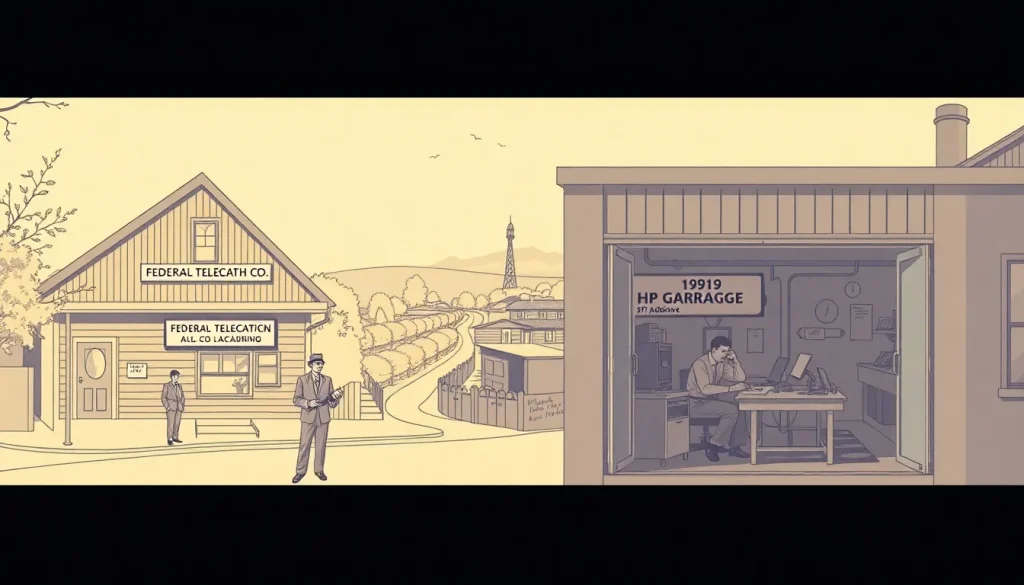
The early electronics companies of Palo Alto, from Federal Telegraph’s pioneering radio experiments in 1909 to the semiconductor spin-offs of the 1950s, transformed a quiet college town into the epicenter of a global technology revolution, fueled by Stanford University’s strategic vision and a culture of entrepreneurial innovation.
Key Dates
| Date | Event |
|---|---|
| 1909 | Cyril Elwell founds Federal Telegraph Company in Palo Alto, soon attracting Lee de Forest. |
| 1912 | De Forest perfects the triode audion amplifier at Federal Telegraph, laying the foundation for modern electronics. |
| 1939 | Bill Hewlett and David Packard form Hewlett-Packard in a garage at 367 Addison Avenue. |
| 1948 | Varian Associates is founded to commercialize the klystron tube, moving to Stanford Industrial Park in 1953. |
| 1951 | Stanford Industrial Park (later Stanford Research Park) is established, the first university-owned high-tech industrial park in the United States. |
| 1956 | William Shockley opens Shockley Semiconductor Laboratory at 391 San Antonio Road, bringing silicon to the valley. |
| 1957 | The “traitorous eight” leave Shockley to found Fairchild Semiconductor, igniting the semiconductor startup culture. |
| 1960 | Palo Alto’s electronics firms number over 40, and the term “Silicon Valley” is on the verge of coinage. |
Geographic Setting
The original landscape of early electronics activity lay in the flatlands between the Santa Cruz Mountains and the southern end of San Francisco Bay, within the boundaries of the 8,800-acre Stanford University land grant. Before the arrival of industry, the area was dominated by orchards, grain fields, and the occasional boarding house. The first electronics laboratories and factories clustered along El Camino Real, the old Spanish road that connected the missions, and near the Southern Pacific railroad tracks that ran parallel to it. The Federal Telegraph Company established its first laboratory in a former residence on Emerson Street, while the iconic HP garage stood in a quiet residential neighborhood near downtown. By the 1950s, the center of gravity shifted south and west toward Page Mill Road, where Stanford Industrial Park rose on former pastureland. Modern-day landmarks for orientation: the HP Garage is at 367 Addison Avenue, a short walk from downtown Palo Alto; the original Shockley Semiconductor site is at 391 San Antonio Road, now a commercial building; and the Stanford Research Park stretches along Page Mill Road from El Camino Real to Foothill Expressway, its low-slung mid-century buildings still housing technology firms.
Origins
The electronics industry in Palo Alto did not begin with a master plan but with a single ambitious engineer. In 1909, Cyril Frank Elwell, a Stanford graduate, founded the Federal Telegraph Company to develop wireless telegraphy systems. Elwell soon recruited Lee de Forest, the inventor of the audion, who was then struggling financially. Working in a cramped laboratory on Emerson Street, de Forest perfected the triode vacuum tube amplifier in 1912—a device that would make possible long-distance telephony, radio broadcasting, and the entire field of electronics. Federal Telegraph itself did not survive the 1920s, but its presence seeded a local expertise in vacuum tube technology and attracted other radio experimenters. The exact date of the first electronics-related startup is disputed; some historians point to earlier electrical firms like the Stanley Electric Manufacturing Company, but Federal Telegraph is widely regarded as the progenitor. Indigenous history in the area is older still: the Ohlone people inhabited the region for millennia, though their presence left no direct imprint on the electronics story. The early electronics pioneers were overwhelmingly white, male, and connected to Stanford’s engineering program, a pattern that would persist for decades.
Growth and Community Life
By the late 1930s, Palo Alto was still a small town of about 16,000 people, but its electronics community was beginning to coalesce. In 1939, two Stanford graduates, Bill Hewlett and David Packard, started a company in a one-car garage behind their rented house on Addison Avenue. Their first product, an audio oscillator, was built using a light bulb as a key component, and their first major customer was Walt Disney Studios. The firm grew slowly during World War II, then exploded in the postwar years, moving to a larger facility on Page Mill Road in 1942. Meanwhile, the Varian brothers—Russell and Sigurd—developed the klystron tube at Stanford before the war, and in 1948 founded Varian Associates to produce it for radar and later medical applications. The company became the first tenant of Stanford Industrial Park in 1953, occupying a sleek, modern building at 611 Hansen Way. Contemporary newspaper accounts reported that the park’s opening was celebrated as a triumph of town-gown cooperation, though some residents grumbled about the loss of open space. The electronics workforce was highly educated and relatively well-paid, but the community remained socially stratified; engineers and executives lived in the foothills, while production workers often commuted from East Palo Alto or San Jose. A 1955 city directory lists over a dozen electronics-related firms, from small machine shops to advanced research labs, many clustered along the Page Mill corridor.
Relationship with Nearby Powers
No single institution shaped the early electronics companies of Palo Alto more than Stanford University, and no individual more than Frederick Terman. Terman, a Stanford electrical engineering professor and later provost, actively encouraged his students to start companies near campus, personally investing in HP and brokering connections between academia and industry. He conceived the Stanford Industrial Park as a “community of technical scholars” where university research could flow seamlessly into commercial application. The university leased land on favorable terms, but retained ownership, creating a perpetual revenue stream and ensuring that the park’s tenants remained compatible with Stanford’s interests. This symbiotic relationship was not without friction. Some city officials worried that the industrial park would drain tax revenue from downtown Palo Alto, while others feared the university’s growing influence over local land use. The city of Palo Alto itself played a supporting role, offering zoning variances and infrastructure improvements, but the driving force was always Stanford. The relationship was one of mutual dependency: the companies needed access to Stanford’s talent and laboratories, and Stanford needed the companies to provide jobs for its graduates and to burnish its reputation as an engine of economic development. This model would later be copied by research universities around the world.
Annexation, Decline, or Transformation
The early electronics era in Palo Alto did not end with annexation or decline but with a radical transformation. The vacuum tube companies that had defined the first wave—Federal Telegraph, Litton Industries, Eitel-McCullough—either moved, closed, or were absorbed by larger firms. The second wave, epitomized by HP and Varian, grew into multinational corporations. The third wave, sparked by the arrival of William Shockley in 1956, shifted the technological paradigm from vacuum tubes to semiconductors. Shockley, a Nobel laureate and co-inventor of the transistor, established his laboratory on San Antonio Road with the intention of mass-producing silicon transistors. His authoritarian management style drove away eight of his brightest researchers—the “traitorous eight”—who in 1957 founded Fairchild Semiconductor with backing from Fairchild Camera and Instrument. Fairchild became the progenitor of dozens of spin-offs, including Intel, and its planar process revolutionized chip manufacturing. By 1960, the term “Silicon Valley” was not yet in common use, but the region’s identity had been permanently recast. The old orchards were disappearing under tilt-up concrete buildings, and the garage startup mythos was already being burnished. The transformation was not a hostile takeover but a rapid, market-driven evolution that left behind a palimpsest of earlier industrial forms.
What Remains Today
Visitors to Palo Alto can still trace the physical remnants of the early electronics era, though many sites have been altered or repurposed. The HP Garage at 367 Addison Avenue, restored to its 1939 appearance, is a designated California Historical Landmark and open for private tours; the adjacent house is a private residence and not open to the public. A plaque on the sidewalk marks the spot. The original Federal Telegraph laboratory on Emerson Street is long gone, replaced by a commercial building, but a small exhibit at the Palo Alto History Museum (when open) documents its history. The Shockley Semiconductor Laboratory building at 391 San Antonio Road still stands, now occupied by a grocery store and other businesses; a state historical marker in the parking lot commemorates the site. The Stanford Research Park along Page Mill Road retains many of its original mid-century buildings, including the Varian Associates headquarters at 611 Hansen Way (now occupied by other firms) and the HP campus at 1501 Page Mill Road. The current building at 367 Addison should not be confused with the original HP workshop, which was the garage itself; the house has been carefully preserved but is not a museum interior. Oral histories collected by the Palo Alto Historical Association in the 1970s and 1980s provide vivid recollections of the early days, including the smell of solder and the sound of vacuum tube testers.
Historical Photographs and Maps
Several key visual sources document the early electronics landscape. A 1941 aerial photograph of Palo Alto, held by the Stanford University Archives, shows the HP garage in its residential context, surrounded by empty lots and small houses, with the university’s Hoover Tower visible in the distance. A 1954 Sanborn fire insurance map, available through the Library of Congress, depicts the Stanford Industrial Park in its infancy, with only a handful of buildings labeled “Varian Associates” and “Research Laboratory” amid vast tracts of undeveloped land. The most iconic image is the 1939 photograph of the HP garage taken by an unknown photographer, showing the cluttered workbench, the drill press, and the cot where Packard sometimes slept; this image has been endlessly reproduced and has become the visual shorthand for Silicon Valley’s origin story. No known photographs of the interior of Federal Telegraph’s Emerson Street laboratory survive, though a 1912 publicity photo of Lee de Forest posing with his audion equipment exists in the collections of the Perham Foundation. A 1960 aerial survey by the U.S. Geological Survey reveals the rapid transformation of the Page Mill corridor, with dozens of new buildings and parking lots replacing orchards.
Historiographical Notes
The story of early electronics in Palo Alto has been told primarily through the lens of its most successful firms, particularly Hewlett-Packard and the semiconductor startups. Early booster histories, such as those commissioned by the Palo Alto Chamber of Commerce in the 1960s, emphasized the role of individual genius and the “pioneering spirit” while downplaying the critical contributions of military contracts and federal research funding. The “garage myth” has been particularly durable, obscuring the fact that HP was not founded in isolation but was part of a larger ecosystem of radio engineers and Stanford mentors. Revisionist historians, including Christophe Lécuyer in Making Silicon Valley (2006), have highlighted the importance of pre-World War II electronics firms like Federal Telegraph and Eitel-McCullough, and have shown how the region’s technical culture was shaped by amateur radio clubs, defense contracts, and the open-shop labor policies that kept unions at bay. The role of women and people of color in the early electronics workforce remains underexplored, though oral histories suggest that assembly lines were often staffed by women of Japanese and Mexican descent. The term “Silicon Valley” itself was coined only in 1971, and its retrospective application to the 1940s and 1950s has flattened the distinct phases of technological development.
Sources and Archives
The most important repository for early electronics history in Palo Alto is the Stanford University Archives, which holds the Frederick Terman Papers, the Hewlett-Packard Company Records, and the Varian Associates Records. The Palo Alto Historical Association maintains a collection of oral histories, city directories, and photographs, including the Guy Miller Papers. The Computer History Museum in Mountain View holds artifacts and documents from Fairchild Semiconductor and Shockley Semiconductor. The Perham Foundation Collection, now at History San Jose, contains early vacuum tubes and Federal Telegraph equipment. For newspaper accounts, the Palo Alto Times (digitized from 1893 to 1960) is invaluable. The Bancroft Library at UC Berkeley holds the Lee de Forest Papers. A particularly useful finding aid is the “Guide to the Stanford Industrial Park Records, 1949–1985” at the Stanford University Archives.
Related People and Places
Frederick Terman (1900–1982): Stanford professor and provost, often called the “father of Silicon Valley.” He mentored Hewlett and Packard, encouraged the creation of Stanford Industrial Park, and shaped the university’s symbiotic relationship with industry. His papers reveal a strategic vision that was both entrepreneurial and deeply tied to Cold War defense priorities.
Bill Hewlett (1913–2001) and David Packard (1912–1996): The co-founders of Hewlett-Packard, whose partnership began in a Palo Alto garage and grew into one of the world’s largest electronics companies. Their management style, known as “the HP Way,” emphasized employee autonomy and innovation.
Lee de Forest (1873–1961): Inventor of the triode audion, which he perfected while working at Federal Telegraph in Palo Alto. Though he later left the area, his work in Palo Alto between 1910 and 1912 was foundational to the electronics industry.
William Shockley (1910–1989): Nobel laureate and co-inventor of the transistor, whose ill-fated Palo Alto laboratory inadvertently sparked the semiconductor revolution by driving away the “traitorous eight.” His legacy is deeply contested due to his later advocacy of eugenics.
Related Places: The HP Garage (367 Addison Avenue) remains the most visited historical site. The Stanford Research Park (Page Mill Road) is a living museum of mid-century industrial architecture. The former Shockley Semiconductor site (391 San Antonio Road) is marked by a plaque. The Federal Telegraph building site on Emerson Street is unmarked but can be located using a 1910 Sanborn map overlay.
FAQ
What was the first electronics company in Palo Alto?
The Federal Telegraph Company, founded in 1909 by Cyril Elwell, is widely considered the first electronics firm in Palo Alto. It specialized in wireless telegraphy and attracted Lee de Forest, who perfected the triode audion amplifier there in 1912.
Why is the HP garage considered the birthplace of Silicon Valley?
The garage at 367 Addison Avenue is where Bill Hewlett and David Packard started their company in 1939. It symbolizes the entrepreneurial spirit and the close ties between Stanford University and the electronics industry that came to define Silicon Valley, though the region’s electronics history predates HP.
What role did Stanford University play in the early electronics industry?
Stanford, particularly under Frederick Terman, actively encouraged faculty and students to start companies, leased land for the Stanford Industrial Park, and fostered a culture of collaboration between academia and industry. This symbiotic relationship was crucial to the growth of electronics firms in Palo Alto.
Leave a Reply