Short Answer
One-Sentence Summary
The Stanford Industrial Park, established in 1951 on university land south of the main campus, transformed a patchwork of orchards and hayfields into a dense cluster of electronics and research firms, creating the spatial and cultural template for Silicon Valley and redefining the relationship between academia, industry, and suburban development.
Key Dates
| Date | Event |
|---|---|
| 1885 | Leland Stanford Junior University founded; its land grant prohibits the sale of the 8,800-acre Palo Alto Stock Farm. |
| 1946 | Frederick Terman returns to Stanford as Dean of Engineering, begins advocating for a “community of technical scholars” that would link university research with local industry. |
| 1951 | Stanford Industrial Park officially launched; Varian Associates signs the first lease for a 10-acre parcel on Page Mill Road. |
| 1953 | Varian Associates moves into its new building, the park’s first completed structure, designed by architect John Carl Warnecke. |
| 1956 | Hewlett-Packard, already a Stanford spin-off, relocates its growing operations to a purpose-built headquarters at 1501 Page Mill Road. |
| 1970 | Xerox Palo Alto Research Center (PARC) opens on Coyote Hill Road, becoming a legendary incubator of the personal computer, graphical user interface, and Ethernet. |
| 1980s | The park reaches near-total build-out; surrounding Sand Hill Road emerges as the world’s densest concentration of venture capital firms. |
| 1990s | Renamed Stanford Research Park to reflect the shift from light manufacturing to pure research and development. |
| 2000s–present | Ongoing redevelopment and densification; the park remains a premier address for tech companies, though its original low-rise, campus-like character is increasingly challenged by multi-story buildings. |
Geographic Setting
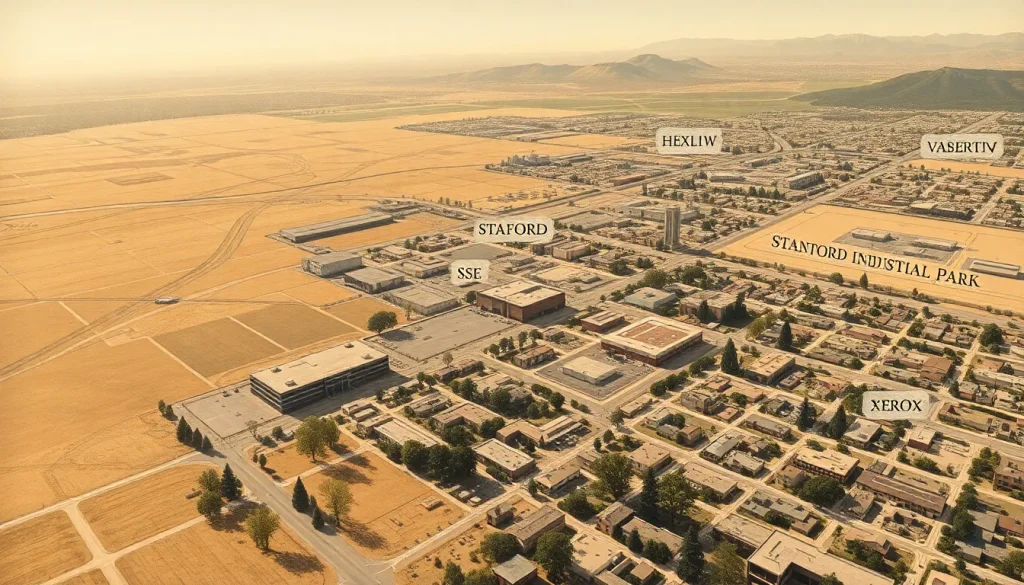
The original Stanford Industrial Park occupied approximately 700 acres of the university’s land grant, situated south of the main campus and west of the Southern Pacific Railroad tracks. The area was bounded roughly by Page Mill Road to the north, Foothill Expressway to the west, and Arastradero Road to the south, with the rolling foothills of the Santa Cruz Mountains rising beyond. Before development, the landscape was a mosaic of dry-farmed grain fields, apricot and prune orchards, and grazing land, part of the former Palo Alto Stock Farm where Leland Stanford bred his famous trotting horses. A seasonal creek, now largely culverted, ran through the site. Today, the park’s tree-lined boulevards and manicured lawns are interspersed with low-rise office buildings, and the area is seamlessly integrated into the suburban fabric of Palo Alto and Los Altos Hills. The original townsite of Mayfield, annexed by Palo Alto in 1925, lies just to the northeast, while the Stanford Shopping Center, built on former agricultural land, marks the park’s northern edge.
Origins
The park’s creation was a direct response to Stanford University’s post-World War II financial predicament. The university’s endowment had been eroded by inflation, and the founding grant by Leland and Jane Stanford explicitly forbade the sale of any land. Frederick Terman, a Stanford electrical engineering professor who had directed a wartime radar countermeasures lab at Harvard, returned in 1946 with a vision: the university could lease its land to technology companies, generating income while creating a symbiotic relationship between academic research and commercial application. Terman’s model drew on his wartime experience with government-funded research and his observation of the close ties between MIT and Route 128 firms in Boston. He actively encouraged his students, including William Hewlett and David Packard, to start companies near the university. The first formal step came in 1951 when the university’s Board of Trustees approved the creation of the Stanford Industrial Park, with Varian Associates—founded by Russell and Sigurd Varian, inventors of the klystron tube—as the anchor tenant. The lease structure was innovative: companies would construct their own buildings on university land under long-term ground leases, with the improvements reverting to Stanford after the lease expired. This arrangement preserved the university’s land ownership while providing a steady revenue stream.
Growth and Community Life
Throughout the 1950s and 1960s, the park attracted a who’s who of early electronics and aerospace firms: Eastman Kodak, Lockheed Missiles and Space, General Electric, and Watkins-Johnson, among others. The architecture was deliberately restrained—one- or two-story buildings with horizontal lines, large windows, and generous setbacks, set amid native oaks and landscaped lawns. This campus-like aesthetic, pioneered by architects such as John Carl Warnecke and the firm of Skidmore, Owings & Merrill, rejected the urban factory model in favor of a suburban, car-oriented ideal that would be replicated across the country. Contemporary newspaper accounts from the Palo Alto Times celebrated the park as a “clean industry” haven that would not pollute the air or attract blue-collar labor unions. The park had no housing, no schools, and no churches; it was a purely commercial landscape, dependent on the surrounding communities for its workforce. By the 1970s, the park employed over 25,000 people, and the daily commute along Page Mill Road and Foothill Expressway became a defining feature of Silicon Valley life. The opening of Xerox PARC in 1970 added a new dimension: a pure research laboratory where computer scientists, many with Stanford ties, developed the Alto personal computer, the laser printer, and the Ethernet protocol. The informal exchange of ideas between PARC researchers, Stanford faculty, and nearby entrepreneurs—often over lunch at the park’s few cafes or at the nearby Rickey’s Hyatt House—created a dense knowledge ecosystem that venture capitalists on Sand Hill Road were quick to exploit.
Relationship with Nearby Powers
The park’s relationship with Stanford University was one of mutual dependence. The university provided not only land but also a steady stream of graduates, consulting opportunities for faculty, and the prestige that attracted top firms. In return, the park generated millions of dollars in lease revenue, which helped transform Stanford into a world-class research institution. The park also reshaped the political economy of the surrounding cities. Palo Alto, which had long viewed Stanford with a mixture of admiration and resentment, saw its tax base swell from the commercial property, but also faced mounting pressure on housing, schools, and infrastructure. The city of Mayfield, which had been annexed decades earlier, was now thoroughly subsumed into the tech economy. Tensions flared over Stanford’s tax-exempt status on its land, with critics arguing that the university was a commercial landlord masquerading as a nonprofit. The park’s success also accelerated the conversion of the remaining orchards in Santa Clara County into subdivisions and shopping centers, a process that local boosters celebrated as progress but that displaced the region’s agricultural workers and erased the “Valley of Heart’s Delight” landscape. The park’s model of low-density, single-use development contributed to the region’s chronic traffic congestion and housing shortages, legacies that are still debated today.
Annexation, Decline, or Transformation
The Stanford Industrial Park never declined in the traditional sense; rather, it transformed. By the 1980s, the original 700 acres were fully leased, and the park’s name was officially changed to Stanford Research Park to reflect the shift from manufacturing to R&D. The semiconductor fabrication plants that had once operated there gave way to software firms, biotech startups, and corporate headquarters. The park’s success spawned imitators across the nation and the world, but it also contributed to the very forces that would make Silicon Valley a victim of its own success: skyrocketing real estate prices, unrelenting traffic, and a widening gap between tech wealth and the service workers who supported it. According to the university’s land use records, the ground lease model remained intact, with Stanford periodically renegotiating terms and reinvesting revenue into academic programs. The park’s evolution mirrored the broader shift from an industrial to a post-industrial economy, and its continued vitality is a testament to the enduring power of Terman’s vision, even as the region grapples with the unintended consequences of that vision.
What Remains Today
A visitor to the Stanford Research Park today can still trace the outlines of its founding vision. The original Varian Associates building at 611 Hansen Way, though expanded and now occupied by multiple tenants, retains its mid-century modern lines and is listed on the Palo Alto Historic Inventory. Hewlett-Packard’s former headquarters at 1501 Page Mill Road, a sprawling complex of interconnected low-rise buildings, still stands, though HP has since moved its corporate offices elsewhere. Xerox PARC continues to operate on Coyote Hill Road, its iconic sign a reminder of the lab’s storied past. The park’s street names—Porter Drive, Hansen Way, Hillview Avenue—echo the names of early Stanford faculty and administrators. The landscaping, with its mature oaks and eucalyptus windbreaks, preserves the agrarian aesthetic that Terman insisted upon. However, the current building at 1501 Page Mill Road should not be confused with the original HP garage at 367 Addison Avenue in Palo Alto, which is a separate landmark. The park’s original design covenants, which restricted building heights and mandated setbacks, have been relaxed in recent years, and several multi-story parking structures and larger office blocks now punctuate the skyline, signaling a new chapter in the park’s evolution.
Historical Photographs and Maps
A 1956 aerial photograph held by the Stanford University Archives shows the park in its infancy: Varian’s building stands alone amid a sea of orchards, with Page Mill Road a narrow two-lane road. A 1970s promotional map produced by the university depicts the park’s expansion, with shaded parcels indicating leased lots and dotted lines marking future phases; the map reveals the careful choreography of land release that maximized revenue and controlled growth. The 1948 U.S. Geological Survey topographic map of the Palo Alto quadrangle, available through the Earth Sciences Library, shows the pre-park landscape in detail: the old Stanford stock farm boundaries, the meandering course of Matadero Creek, and the grid of ranch roads that would later become the park’s main arteries. No known photographs of the original Varian groundbreaking ceremony survive, but oral histories collected by the Palo Alto Historical Association describe a modest event with a handful of university officials and company founders.
Historiographical Notes
The story of the Stanford Industrial Park has been told primarily through the lens of its most famous chroniclers: Frederick Terman himself, who in later interviews framed the park as a deliberate, almost inevitable outcome of his “steeples of excellence” strategy, and early Silicon Valley boosters who celebrated the park as the cradle of innovation. This narrative, while not inaccurate, tends to downplay the role of federal defense spending, which provided the initial contracts that sustained firms like Varian and Lockheed, and the contributions of the thousands of assembly-line workers, many of them women and immigrants, whose labor filled the park’s early production lines. Recent revisionist work by historians such as Christophe Lécuyer and Margaret O’Mara has situated the park within broader patterns of Cold War science policy, suburbanization, and racial segregation, noting that the park’s restrictive covenants and car-dependent design effectively excluded non-white and working-class communities from its economic benefits. Early county histories, written by prominent landowners and university officials, tend to downplay the displacement of the Japanese-American farming families who had leased the land before World War II and were unable to return after internment. The park’s legacy is thus a contested one, celebrated as a model of university-industry collaboration while also critiqued as a driver of inequality and environmental degradation.
Sources and Archives
The most important repository for primary sources is the Stanford University Archives, which holds the Frederick E. Terman Papers (including correspondence, memos, and early park planning documents), the records of the Stanford Board of Trustees, and a rich collection of photographs and maps. The Palo Alto Historical Association maintains oral history interviews with early park employees and city officials, as well as clipping files from the Palo Alto Times and the Peninsula Times Tribune. The Silicon Valley Archives, housed at Stanford’s Green Library, contain the records of Varian Associates and other early tenants. The Computer History Museum in Mountain View holds artifacts and documents related to Xerox PARC. For understanding the pre-park landscape, the California Room at the San José Public Library offers Sanborn fire insurance maps and agricultural extension reports. The finding aid for the Terman Papers (SC0160) is available online and provides a detailed inventory of the park’s early administrative history.
Related People and Places
Frederick Terman (1900–1982): The architect of the Stanford Industrial Park, Terman served as dean of engineering and later provost of Stanford. His vision of a university-industry partnership, often called the “Terman model,” was instrumental in attracting federal research dollars and fostering spin-off companies. He personally mentored Hewlett and Packard and helped secure the early leases for the park.
William Hewlett (1913–2001) and David Packard (1912–1996): The founders of Hewlett-Packard, the archetypal Stanford spin-off. Their decision to move HP to the park in 1956 signaled to the electronics industry that the park was the place to be. Packard later served on Stanford’s Board of Trustees and was a key figure in the park’s expansion.
Russell and Sigurd Varian: The brothers who invented the klystron tube and founded Varian Associates, the park’s first tenant. Their company’s success in microwave technology, driven by defense contracts, set the pattern for the park’s early focus on electronics and aerospace.
Xerox PARC (Palo Alto Research Center): Opened in 1970 as a division of Xerox Corporation, PARC became a legendary research lab where the graphical user interface, the mouse, Ethernet, and laser printing were developed. Its presence cemented the park’s reputation as a center of pure research and attracted a generation of computer scientists.
Sand Hill Road: The short stretch of road that runs along the park’s northern edge, which by the 1980s had become the world’s premier address for venture capital firms. The proximity of venture capitalists to the park’s startups created a feedback loop of funding and innovation that is a hallmark of Silicon Valley.
Mayfield: The former town, now part of south Palo Alto, that was annexed in 1925. Its working-class, railroad-oriented community was gradually displaced by the park’s expansion and the suburbanization it spurred, a reminder of the region’s layered past.
FAQ
Why did Stanford create an industrial park instead of selling the land?
The university's founding grant by Leland and Jane Stanford prohibited the sale of any land. Leasing the land through long-term ground leases allowed Stanford to generate revenue while retaining ownership, a strategy devised by Frederick Terman to fund the university's post-war expansion.
What was the first company to move into the Stanford Industrial Park?
Varian Associates, founded by Russell and Sigurd Varian, signed the first lease in 1951 and moved into its new building in 1953. The company specialized in microwave tubes and had close ties to Stanford's physics and engineering departments.
How did the park influence the development of Silicon Valley?
The park provided a physical and cultural template for the region: a low-rise, campus-like environment where university research, venture capital, and corporate R&D could interact. It attracted a critical mass of electronics firms, spurred the growth of venture capital on Sand Hill Road, and established the model of the suburban office park that came to define Silicon Valley's landscape.
Is the Stanford Research Park still active today?
Yes, it remains a thriving center for technology and research companies, still owned by Stanford University. While the original low-rise character has been modified with some taller buildings, the park continues to house major firms and startups, and the ground lease model persists.
Leave a Reply