Short Answer
Quick Answer
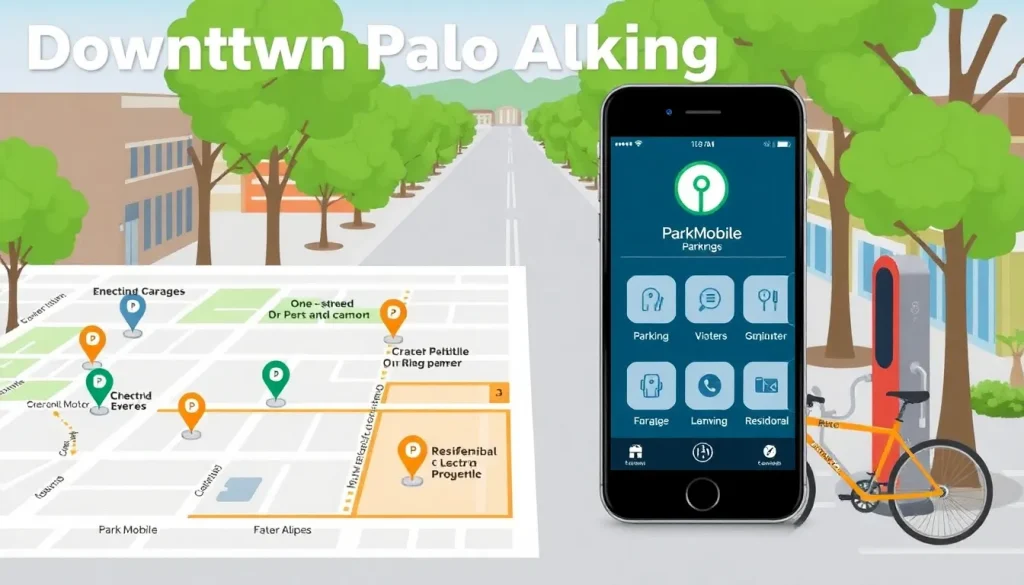
Parking in Downtown Palo Alto is a city-managed system of on-street metered spaces, five public parking garages, and residential permit zones designed to balance the needs of visitors, businesses, and residents. As of 2025, on-street meters cost $1.50 per hour with a two-hour limit, while garages charge $1.00 per hour. Payment is primarily handled through the ParkMobile app, and enforcement runs Monday through Saturday, 8 a.m. to 6 p.m., with free parking on Sundays and city holidays.
What Is Parking in Downtown Palo Alto?
Downtown Palo Alto’s parking system is a comprehensive framework of publicly owned and managed parking assets that serve the city’s primary commercial and cultural core. The district, roughly bounded by Alma Street to the west, Middlefield Road to the east, Lytton Avenue to the north, and Forest Avenue to the south, contains approximately 3,200 public parking spaces. These spaces are distributed among on-street metered stalls, five multi-level parking structures, and two surface lots. The system is not merely a collection of spaces; it is a policy tool used to manage traffic congestion, support local businesses, and protect the quality of life in adjacent residential neighborhoods.
Purpose and Scope
The overarching goal of downtown parking management is to ensure that parking supply is used efficiently while encouraging alternative modes of transportation. The City of Palo Alto explicitly ties parking policy to its broader climate and transportation goals, seeking to reduce single-occupancy vehicle trips and greenhouse gas emissions. To that end, the city has moved away from minimum parking requirements for new developments and instead employs a Parking and Transportation Demand Management (PTDM) ordinance that requires developers to implement strategies—such as transit passes, bike facilities, and unbundled parking—to reduce car dependency. The public parking supply is intended to serve short-term visitors, shoppers, and diners, while long-term commuter parking is discouraged through time limits and pricing.
Historical Context
The Downtown Parking District was established in the 1970s as the city’s commercial center grew and on-street parking became increasingly scarce. The first public garage, the City Hall Garage, opened in 1974. Over the following decades, additional structures were built, including the Bryant/Lytton, Cowper/Webster, and High/Emerson garages. In 2014, the city adopted the PTDM ordinance, a landmark shift from conventional parking mandates to a performance-based approach. The most recent comprehensive policy framework, the Downtown Parking Management Plan, was adopted in 2019 and continues to guide investments in technology, wayfinding, and demand-responsive pricing.
Who Manages It?
The City of Palo Alto’s Department of Planning and Community Environment, through its Transportation Division, sets parking policy, rates, and long-term strategy. Day-to-day enforcement is carried out by the Parking Enforcement unit within the Palo Alto Police Department. The City Council has final authority over rate changes and major policy shifts. Residents and visitors can contact Parking Services at (650) 329-2259 or visit the city’s official website for permits, citations, and general information. The city also partners with ParkMobile for digital payments and with third-party vendors for garage equipment maintenance.
Current Status
As of January 2025, the city is piloting demand-based pricing in the Cowper/Webster Garage, where hourly rates may fluctuate between $1.00 and $2.00 depending on occupancy levels. The standard on-street meter rate remains $1.50 per hour with a two-hour maximum stay, enforced Monday through Saturday from 8 a.m. to 6 p.m. All five public garages—City Hall, Bryant/Lytton, Cowper/Webster, High/Emerson, and the recently renovated Palo Alto Square Garage—charge $1.00 per hour, with a daily maximum of $12.00. Parking is free on Sundays and on designated city holidays. The ParkMobile app is the primary payment method for both on-street and garage spaces, though coin and credit card pay stations are still available at most locations. The city has also completed installation of new multi-space meters that accept contactless payments and display real-time availability data.
The PTDM ordinance continues to apply to all new commercial and residential developments, requiring transportation demand management plans that reduce parking demand by at least 20% below standard industry estimates. The city’s Downtown Parking Management Plan is in its implementation phase, with ongoing projects including improved signage, a centralized parking availability dashboard, and expanded electric vehicle charging infrastructure.
How Residents Use It
Whether you are a visitor looking for a quick errand spot or a resident seeking a long-term permit, the process is straightforward. Follow the steps below for the most common scenarios.
- Choose your parking location. For short visits (under two hours), on-street metered spaces are convenient. For longer stays, use one of the five public garages. Check the city’s interactive parking map or the ParkMobile app for real-time garage occupancy.
- Pay for parking. Download the ParkMobile app, create an account, and enter the zone number posted on signs or pay stations. Alternatively, use a pay station with coins or a credit card. Garage payments can also be made at exit gates via credit card.
- Observe time limits and regulations. On-street meters have a strict two-hour limit; overstaying may result in a citation. Garages allow all-day parking but charge the daily maximum after a certain number of hours. Always check posted signs for street sweeping or special event restrictions.
- Apply for a residential permit if eligible. Residents living within a designated Residential Preferential Parking (RPP) zone can apply online through the city’s parking portal. You will need proof of residency (utility bill, lease) and current vehicle registration. The first permit costs $50 per year, with additional permits available at higher fees. Permits are decals affixed to the vehicle and exempt the holder from meter and time-limit restrictions within their zone.
Relevant Map or Dataset
The City of Palo Alto maintains an interactive Downtown Parking Map that displays the locations of all public parking garages, surface lots, on-street metered spaces, and Residential Preferential Parking zones. The map is accessible through the city’s website and is integrated into the ParkMobile app. It allows users to see real-time garage occupancy (where sensors are installed) and to navigate directly to a chosen facility. The underlying dataset, “Downtown Parking Inventory,” is available on the City of Palo Alto Open Data Portal and includes attributes such as space type, rate, time limit, and accessibility features.
| Data Point | Description | Source |
|---|---|---|
| Total public parking spaces | Approximately 3,200 spaces in garages, lots, and on-street meters | City of Palo Alto Downtown Parking Management Plan (2019) |
| Number of public garages | 5 multi-level structures | City of Palo Alto Parking Services |
| On-street meter rate | $1.50 per hour, 2-hour maximum | City of Palo Alto Municipal Code |
| Garage hourly rate | $1.00 per hour, $12.00 daily maximum | City of Palo Alto Parking Services |
| Residential permit cost | $50 per year for first permit | City of Palo Alto RPP Program |
| Enforcement hours | Monday–Saturday, 8 a.m.–6 p.m. | City of Palo Alto Police Department |
Key Terminology
- Preferential Parking District: A designated area where on-street parking is restricted to residents with permits during certain hours, intended to prevent commuter spillover.
- Parking and Transportation Demand Management (PTDM): A city ordinance requiring new developments to implement measures that reduce single-occupancy vehicle trips and parking demand, such as transit subsidies, bike parking, and car-share memberships.
- ParkMobile: A mobile application that allows users to pay for parking digitally, extend sessions remotely, and receive alerts before time expires. It is the official payment partner for downtown Palo Alto.
- Residential Preferential Parking (RPP): A permit program that exempts eligible residents from meter fees and time limits within their specific zone, ensuring they can park near their homes.
- Downtown Parking District: The geographic area encompassing the city’s central business district where special parking regulations, rates, and management strategies apply.
Limitations and Caveats
While the city provides extensive parking resources, several limitations exist. Real-time occupancy data is only available for garages equipped with sensors; on-street availability is not tracked dynamically. The interactive map may not reflect temporary closures due to construction, events, or maintenance. Residential permit zones have waitlists in some areas, and eligibility is strictly tied to address. The total public space count does not include privately owned lots that may offer public parking at different rates. Additionally, the city’s parking data is updated on a quarterly basis, so the Open Data Portal may not reflect the most recent changes in rates or regulations. During peak hours—particularly weekday lunchtimes and weekend evenings—finding an available space can still be challenging despite the overall supply.
Update History
- 2025-01-15: City Council approved a one-year demand-based pricing pilot for the Cowper/Webster Garage.
- 2024-07-01: Garage daily maximum increased from $10.00 to $12.00.
- 2023-03-01: ParkMobile became the primary payment method; coin-only meters phased out.
- 2022-07-01: New on-street meter rate of $1.50 per hour and standardized enforcement hours implemented.
- 2020-03-17: COVID-19 emergency order temporarily suspended meter enforcement and garage fees; normal operations resumed in phases through 2021.
- 2019-06-01: Downtown Parking Management Plan adopted by City Council.
Official Sources
- City of Palo Alto Parking Services: https://www.cityofpaloalto.org/Departments/Police/Parking-Enforcement
- Downtown Parking Management Plan: https://www.cityofpaloalto.org/Departments/Planning-and-Community-Environment/Transportation/Downtown-Parking-Management-Plan
- ParkMobile: https://parkmobile.io/
- Palo Alto Municipal Code, Chapter 10.44 (Parking): https://library.municode.com/ca/palo_alto/codes/code_of_ordinances
- City of Palo Alto Open Data Portal: https://data.cityofpaloalto.org/
FAQ
How do I pay for parking in downtown Palo Alto?
The easiest method is the ParkMobile app, which lets you pay by smartphone using a zone number. You can also use coin or credit card at on-street pay stations, or credit card at garage exit gates. Cash is not accepted at most locations.
Where can I find free parking downtown?
Free parking is available on Sundays and on designated city holidays in all public garages and at on-street meters. There are no permanently free public spaces during enforcement hours. Some private lots may offer limited free validation with purchase.
How do I get a residential parking permit?
If you live in a Residential Preferential Parking (RPP) zone, apply online through the city's parking portal. You'll need proof of residency (utility bill, lease) and current vehicle registration. The first permit costs $50 per year. Permits are decals that exempt you from meter and time-limit rules in your zone.
What is the PTDM program and how does it affect parking?
The Parking and Transportation Demand Management (PTDM) ordinance requires new developments to implement measures that reduce car trips and parking demand. This means new buildings often provide fewer parking spaces than older ones, but they must offer alternatives like transit passes, bike storage, and car-share memberships to offset the reduction.
Are there electric vehicle charging stations in downtown parking garages?
Yes, several public garages, including the City Hall and Cowper/Webster garages, have EV charging stations. The city is expanding charging infrastructure as part of its sustainability goals. Charging fees may apply in addition to parking rates.


Leave a Reply