Short Answer
Location
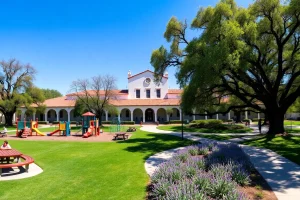
The Lucie Stern Community Center is situated at 1305 Middlefield Road in the heart of Palo Alto, California, within the city’s Central Palo Alto neighborhood. The 2.5-acre complex is bounded by Middlefield Road to the west, Embarcadero Road to the north, and quiet residential streets to the east and south. Its location places it just a few blocks from the bustling commercial corridors of University Avenue and within walking distance of the Palo Alto Caltrain station, making it a central gathering point for the community. The site is also adjacent to the Rinconada Cultural Park, home to the Palo Alto Art Center and the Junior Museum and Zoo, forming a contiguous cultural campus that has served the region for nearly a century.
Why It Is Significant
The Lucie Stern Community Center stands as one of the most important civic landmarks in Palo Alto, representing a rare convergence of private philanthropy, distinguished architecture, and enduring community service. Conceived during the Great Depression, the center was a transformative gift from Lucie Stern, a widow who channeled her wealth into creating spaces for recreation, arts, and civic engagement. Its design by Birge Clark, the preeminent local architect of the era, established a Spanish Colonial Revival aesthetic that would influence Palo Alto’s architectural identity for decades. Today, the center remains a vibrant hub, hosting over 100,000 visitors annually for theatre performances, classes, weddings, and public meetings. It is listed on the Palo Alto Historic Inventory as a Category 1 landmark, denoting its exceptional significance to the city’s heritage.
Historical Timeline
| Year | Event |
|---|---|
| 1931 | Lucie Stern, widow of Levi Strauss heir Sigmund Stern, proposes to donate a community center to Palo Alto in memory of her husband. |
| 1932 | Architect Birge Clark is commissioned to design the complex; site selected on former orchard land. |
| 1933 | Construction begins on the main building, ballroom, and children’s theatre. |
| 1935 | Lucie Stern Community Center officially dedicated on May 4, 1935, with a grand public celebration. |
| 1936 | Palo Alto Players theatre company founded and begins performing in the Lucie Stern Theatre. |
| 1940s | Center serves as a Red Cross headquarters and USO venue during World War II. |
| 1970s | Major interior renovations modernize facilities while preserving historic character. |
| 1981 | Complex added to the Palo Alto Historic Inventory as a Category 1 landmark. |
| 2000s | Seismic retrofitting and accessibility upgrades completed; courtyard restored. |
| 2020s | Continues as a premier venue for community events, classes, and performances. |
Architectural or Natural Characteristics
Spanish Colonial Revival Design
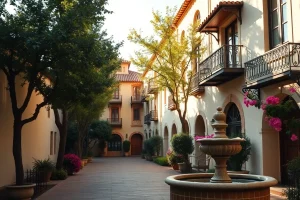
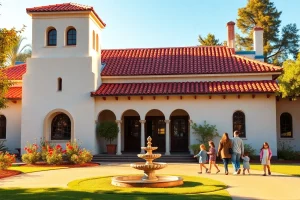
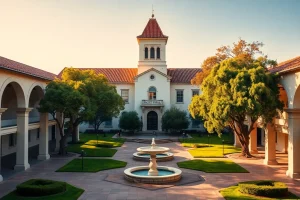
The Lucie Stern Community Center is a textbook example of the Spanish Colonial Revival style, characterized by its low-pitched red tile roofs, smooth stucco walls, arched doorways, and wrought-iron details. Birge Clark, a Stanford-educated architect who studied the missions of California, infused the design with authentic regional touches. The main building’s asymmetrical massing, recessed porches, and decorative tile work evoke the romance of early California haciendas while accommodating modern community functions.
Layout and Structures
The complex comprises four interconnected yet distinct structures arranged around a central landscaped courtyard. The Main Building houses administrative offices, meeting rooms, and the Fireside Room, a warm gathering space with a large hearth. The Ballroom, with its exposed wooden trusses and sprung dance floor, accommodates up to 300 guests. The Lucie Stern Theatre, a 400-seat proscenium venue, features excellent acoustics and an intimate atmosphere. The Children’s Theatre, a smaller performance space, was specifically designed for youth programming. The courtyard, shaded by mature oaks and adorned with a central fountain, serves as an outdoor living room for the community.
Materials and Craftsmanship
Clark employed high-quality materials throughout, including hand-hewn wooden beams, decorative ceramic tiles from California potteries, and wrought-iron light fixtures crafted by local artisans. The stucco exterior is painted in a warm cream tone, accented by blue trim on windows and doors—a color palette inspired by Mediterranean coastal towns. Original tile murals depicting scenes of early California life grace the entrance foyer, while the ballroom’s chandeliers are replicas of those found in Spanish missions.
Cultural Meaning
The Lucie Stern Community Center embodies the democratic ideals of the early 20th-century community center movement, which sought to provide accessible spaces for education, recreation, and civic participation. For Palo Alto, it represents the legacy of a single donor whose vision shaped the city’s cultural landscape. The center has nurtured generations of artists through the Palo Alto Players, one of the oldest continuously operating community theatre companies on the West Coast. It has hosted countless weddings, quinceañeras, political forums, and memorial services, weaving itself into the fabric of local life. During World War II, it served as a home front hub, and in the 1960s, it provided a forum for civil rights discussions. Today, it stands as a symbol of Palo Alto’s commitment to preserving its heritage while serving a diverse, modern population.
Visiting Information
Hours and Access
- Administrative Offices: Monday–Friday, 9:00 AM–5:00 PM
- Community Events: Vary by schedule; check the City of Palo Alto website for current offerings.
- Theatre Performances: Typically evenings and weekends; tickets available through the Palo Alto Players box office.
- Courtyard: Open daily from dawn to dusk, free of charge.
Rentals
The Ballroom, Fireside Room, and outdoor courtyard are available for private event rentals. Reservations can be made through the City of Palo Alto’s Community Services Department. Rates vary by space and duration.
Parking
Free on-site parking is available in the lot accessed from Middlefield Road, with additional street parking on surrounding blocks. The center is also a short walk from the Palo Alto Caltrain station and served by VTA bus routes.
Accessibility
The Lucie Stern Community Center is committed to universal access. All public entrances are wheelchair-accessible via ramps and automatic doors. The theatre offers designated wheelchair seating and assistive listening devices. Accessible restrooms are located in the main building and near the ballroom. Service animals are welcome. For specific accommodation requests, visitors are encouraged to contact the facility in advance.
Preservation Status
The complex is designated as a Category 1 landmark on the Palo Alto Historic Inventory, the highest level of protection, which requires review of any exterior alterations. A comprehensive seismic retrofit completed in the early 2000s brought the unreinforced masonry structures up to modern safety standards without compromising historic fabric. The City of Palo Alto, which owns and operates the center, has an ongoing maintenance program that includes roof repairs, stucco restoration, and landscape preservation. The Lucie Stern Foundation continues to support capital improvements, ensuring the center remains a functional and beautiful space for future generations.
Common Misconceptions
Map
FAQ
What is the Lucie Stern Community Center used for?
The center hosts a wide range of activities including theatre performances by the Palo Alto Players, community classes, public meetings, private events such as weddings and receptions, and youth programs. Its ballroom, meeting rooms, and courtyard are available for rental.
Is the Lucie Stern Community Center open to the public?
Yes, the courtyard is open daily from dawn to dusk, and the buildings are accessible during scheduled events and office hours. Visitors are welcome to explore the grounds and appreciate the architecture.
Can I rent the Lucie Stern Community Center for an event?
Yes, the Ballroom, Fireside Room, and outdoor courtyard can be rented for private functions. Reservations are managed by the City of Palo Alto's Community Services Department, and fees vary based on the space and duration.
Who was Lucie Stern?
Lucie Stern (1868–1946) was a philanthropist and the widow of Sigmund Stern, a nephew of Levi Strauss. She used her inheritance to fund numerous civic projects in Palo Alto and San Francisco, including the community center that bears her name, the Lucie Stern Theatre, and several parks.
What architectural style is the building?
The Lucie Stern Community Center is designed in the Spanish Colonial Revival style, popular in California during the 1920s and 1930s. It features red tile roofs, stucco walls, arched openings, and a central courtyard.
Leave a Reply