Short Answer
Introduction
In the heart of Silicon Valley, where tech campuses and venture capital firms now dominate the landscape, the memory of a vanished town lingers in street names, historic buildings, and the character of a beloved business district. Mayfield, once a thriving independent municipality, was absorbed by its larger neighbor Palo Alto in 1925 after decades of political maneuvering, cultural clashes, and economic transformation. This is the story of how a stagecoach stop grew into a rowdy railroad town, defied the temperance-minded founders of Stanford University, and ultimately became an integral part of one of the world’s most innovative cities. Understanding Mayfield’s journey offers a window into the forces that shaped the San Francisco Peninsula—from the Gold Rush era to the dawn of the automobile age—and provides timeless lessons about identity, consolidation, and the preservation of local heritage.
Overview
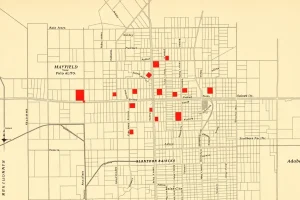
Mayfield was a small, unincorporated settlement that evolved into an incorporated town in Santa Clara County, California, before being annexed by the city of Palo Alto in 1925. Its story is deeply intertwined with the arrival of the railroad, the founding of Stanford University, and the prohibition movement of the early 20th century. Geographically, Mayfield occupied the area that now encompasses the California Avenue business district, the College Terrace neighborhood, and parts of the Stanford Research Park. At its peak, Mayfield boasted a population of roughly 1,200 residents, a bustling commercial core, and a reputation as a “wet” town in a region increasingly dominated by temperance sentiment. Today, its legacy endures in the form of historic buildings, street names, and a distinct neighborhood identity that still sets the area apart from the rest of Palo Alto.
Key Concepts
Origins and Early Settlement
The area that would become Mayfield was originally inhabited by the Ohlone people, who lived in the region for thousands of years before European contact. Spanish explorers and missionaries arrived in the late 18th century, establishing the nearby Mission Santa Clara and Mission San Jose. Following Mexican independence, the land was granted to individuals as ranchos. The area of Mayfield fell within Rancho Rincon de San Francisquito and Rancho San Antonio.
After the Mexican-American War and California’s statehood in 1850, Anglo-American settlers began arriving. The first known non-Native settler in the Mayfield area was Elisha Crosby, who built a cabin in 1853 near what is now the intersection of California Avenue and El Camino Real. The location was strategic: it sat along the primary route between San Jose and San Francisco, making it a natural stopping point for stagecoaches. In 1855, a stagecoach station and tavern were established, and the settlement was named “Mayfield” after the daughter of one of the early landowners, or possibly after a local family—historical accounts differ.
The Railroad and Economic Growth
The arrival of the San Francisco and San Jose Railroad in 1864 transformed Mayfield from a sleepy waystation into a thriving agricultural shipping center. The railroad line, which later became part of the Southern Pacific system, ran directly through the settlement, and a depot was built at what is now the California Avenue Caltrain station. Farmers from the surrounding orchards and grain fields used the railroad to ship produce to San Francisco markets. The depot also attracted hotels, saloons, and general stores, creating a compact commercial core along what was then called Lincoln Avenue (now California Avenue).
By the 1880s, Mayfield had a post office, a school, several churches, and a growing population of farmers, merchants, and railroad workers. The town’s economy was based on agriculture—primarily wheat, barley, and fruit orchards—as well as services for travelers and railroad employees. The Southern Pacific Railroad became the largest employer and landowner in the area, and its influence would later play a decisive role in the annexation battle.
Stanford University and the Birth of Whiskey Gulch
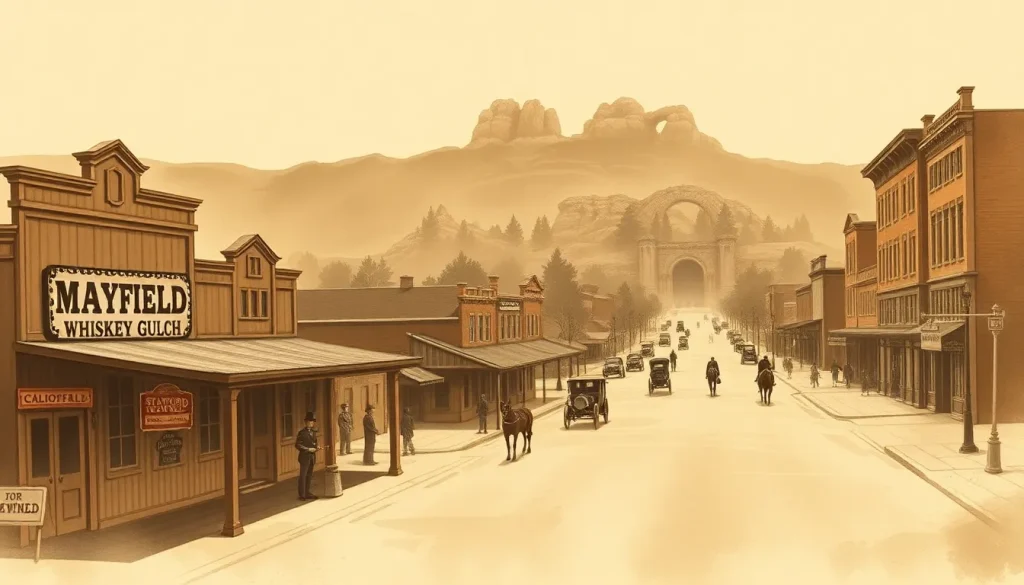
The single most consequential event in Mayfield’s history was the founding of Stanford University in 1891. Leland and Jane Stanford established the university on their vast Palo Alto Stock Farm, located just north of Mayfield. The Stanfords imposed a strict prohibition on alcohol within a one-mile radius of the campus, a rule that extended into the adjacent town of Palo Alto but stopped at Mayfield’s border. Almost overnight, Mayfield became the primary destination for students, faculty, and visitors seeking liquor. A cluster of saloons sprang up along the southern edge of the university lands, an area quickly nicknamed “Whiskey Gulch.”
At its height, Whiskey Gulch boasted more than a dozen saloons, dance halls, and gambling establishments. The most famous was the “Dutch Goose,” a bar that operated for decades and became a legendary hangout for Stanford students. The saloon culture defined Mayfield’s identity for a generation, creating a sharp contrast with the dry, morally upright atmosphere of Palo Alto. This cultural divide would fuel decades of political conflict and ultimately seal Mayfield’s fate.
Incorporation and Municipal Identity
In 1903, Mayfield’s residents voted to incorporate as a town, seeking greater control over local affairs and protection from annexation by Palo Alto. The new town had a board of trustees, a marshal, and a volunteer fire department. Its boundaries encompassed approximately 1.2 square miles, stretching from the Southern Pacific tracks to the foothills and from the Stanford lands to the present-day Oregon Expressway. The population at incorporation was about 800.
Mayfield’s incorporation was a direct response to Palo Alto’s rapid growth and its temperance-driven politics. Palo Alto, founded in 1894, had already banned saloons and was actively promoting itself as a “dry” city ideal for families and education. Mayfield’s leaders saw incorporation as a way to preserve their town’s independent, working-class character and its lucrative liquor trade. However, the town struggled financially from the start, lacking a strong tax base and relying heavily on saloon license fees.
The Annexation Battle
The movement to annex Mayfield into Palo Alto gained momentum in the 1910s, driven by several factors. First, the temperance movement was sweeping the nation, and many Palo Alto residents viewed Mayfield’s saloons as a moral blight on the community. Second, Palo Alto was expanding rapidly and needed room for residential development; Mayfield’s flat, undeveloped land was highly desirable. Third, the Southern Pacific Railroad, which owned significant property in Mayfield, saw economic advantage in consolidation and threw its political weight behind annexation.
The annexation fight was bitter and protracted. Mayfield residents were deeply divided. Pro-annexation advocates argued that joining Palo Alto would bring better schools, paved streets, sewer systems, and police protection. Opponents feared the loss of their town’s identity, higher taxes, and the forced closure of the saloons that provided jobs and revenue. Multiple elections were held between 1915 and 1925, with annexation repeatedly failing to secure the required two-thirds majority. The turning point came in 1924, when a coalition of business leaders, railroad officials, and pro-consolidation residents mounted an aggressive campaign. They promised infrastructure improvements and downplayed the saloon issue. On July 7, 1925, a special election finally passed the annexation measure by a narrow margin—1,094 votes in favor to 997 against. Mayfield officially ceased to exist as an independent town on August 1, 1925.
Benefits
Infrastructure and Public Services
Annexation brought immediate improvements to Mayfield’s infrastructure. Palo Alto extended its water and sewer systems, paved the dirt streets, and installed streetlights. The volunteer fire department was replaced by Palo Alto’s professional force, and police protection was upgraded. Within a few years, the former Mayfield area had access to the same municipal services as the rest of Palo Alto, dramatically improving quality of life for residents.
Educational Opportunities
Mayfield’s schools were absorbed into the Palo Alto Unified School District, which was already gaining a reputation for excellence. Students from the former Mayfield area gained access to better-funded schools, including the newly built Palo Alto High School. This integration helped break down the social barriers between the two communities over time.
Economic Integration
As part of Palo Alto, the former Mayfield area benefited from the city’s growing economy. The California Avenue business district evolved from a row of saloons and general stores into a vibrant commercial center serving the surrounding neighborhoods. The establishment of the Stanford Research Park in the 1950s on former Mayfield land brought high-tech jobs and cemented the area’s role in Silicon Valley’s rise.
Cultural and Civic Identity
While Mayfield lost its political independence, its unique character did not disappear. The California Avenue district retained its small-town feel, with locally owned shops, restaurants, and a farmers’ market that continues to this day. The College Terrace neighborhood, developed on Mayfield’s former orchard lands, became a desirable residential area with a strong sense of community. In many ways, the annexation allowed Mayfield’s best qualities to endure while shedding the problems that had plagued the independent town.
Challenges
Loss of Local Autonomy
The most immediate and painful consequence of annexation was the loss of self-governance. Mayfield’s town board was dissolved, and all municipal decisions were made by the Palo Alto City Council, where former Mayfield residents were a minority. Many felt their voices were drowned out by the larger, wealthier population to the north. This resentment simmered for decades and occasionally flared up in local politics.
Closure of the Saloons
One of the first acts of the newly expanded Palo Alto was to enforce its prohibition ordinance throughout the annexed territory. Within months, all of Mayfield’s saloons were closed. Whiskey Gulch vanished almost overnight. While temperance advocates celebrated, many Mayfield residents lost their livelihoods, and the town’s social fabric was torn apart. The closure also eliminated a significant source of municipal revenue, though Palo Alto’s larger tax base absorbed the loss.
Cultural Clashes
The merger of a working-class, saloon-friendly town with a dry, upper-middle-class city created cultural friction. Mayfield residents were often stereotyped as rowdy and unrefined, while Palo Altans were seen as elitist and condescending. These tensions played out in school board meetings, social clubs, and everyday interactions. It took a generation for the two communities to fully integrate socially.
Economic Displacement
The closure of the saloons and the shift toward a more suburban, residential development pattern displaced many of Mayfield’s original businesses and residents. Property values rose, and some long-time families were forced to move. The transformation of agricultural land into housing tracts and research parks further altered the area’s character, replacing orchards with office buildings and subdivisions.
Best Practices
Lessons in Municipal Consolidation
The Mayfield-Palo Alto annexation offers valuable lessons for modern municipal consolidations. First, the importance of inclusive governance cannot be overstated. The perception that Mayfield’s interests were ignored fueled decades of resentment. Successful consolidations today often include guaranteed representation, phased integration of services, and community advisory boards.
Second, economic integration must be carefully managed to avoid displacing existing residents and businesses. Incentives for local entrepreneurship, affordable housing policies, and historic preservation can help maintain community character during growth.
Third, cultural sensitivity is critical. The clash between Mayfield’s saloon culture and Palo Alto’s temperance values was a zero-sum conflict that left deep scars. Modern consolidations benefit from acknowledging and respecting the distinct identities of merging communities, rather than imposing one set of values on another.
Preserving Local Heritage
Mayfield’s story underscores the importance of historic preservation. While many of the original buildings were lost to redevelopment, a concerted effort in the late 20th century saved several key structures. The Mayfield School (now a community center), the historic post office building, and a handful of Victorian-era homes still stand as tangible reminders of the town’s past. These preservation efforts were driven by grassroots activism and partnerships between the city, historical societies, and neighborhood groups—a model for other communities facing similar challenges.
Tools & Resources
Archival Collections
- Palo Alto Historical Association Archives: Holds photographs, maps, newspapers, and oral histories related to Mayfield. Located at the Palo Alto Main Library.
- Stanford University Archives: Contains records of the university’s interactions with Mayfield, including correspondence about the saloon issue and land acquisitions.
- California State Library: Houses incorporation records, election results, and legal documents pertaining to the annexation.
Digital Resources
- City of Palo Alto Historic Inventory: An online database of historic properties, including many in the former Mayfield area.
- Sanborn Fire Insurance Maps: Detailed maps from 1884–1925 showing the layout of Mayfield’s buildings, available through the Library of Congress.
- Online Archives of the Palo Alto Times and Mayfield Enterprise: Digitized newspapers covering the annexation debate.
Recommended Reading
- Winslow, Ward. Palo Alto: A Centennial History. Palo Alto Historical Association, 1994.
- Gullard, Pamela, and Nancy Lund. The Story of Palo Alto. Scottwall Associates, 1989.
- Chapman, Robin. Historic Palo Alto: The Story of a City and Its Buildings. Heritage Media, 2005.
Future Trends
Ongoing Development and Gentrification
The California Avenue area continues to evolve. Recent years have seen an influx of tech offices, upscale restaurants, and luxury housing, raising concerns about gentrification and the loss of the district’s historic character. The city of Palo Alto has implemented zoning changes and design guidelines to balance growth with preservation, but tensions remain. The future of the area will likely involve continued densification, particularly near the Caltrain station, as part of regional transit-oriented development goals.
Historic Preservation Efforts
Community groups such as the College Terrace Residents Association and the Palo Alto Historical Association are actively working to document and preserve Mayfield’s legacy. Efforts include nominating remaining historic structures for landmark status, creating interpretive signage, and organizing walking tours. In 2025, the centennial of the annexation is expected to bring renewed attention to Mayfield’s history, with planned exhibitions and public events.
Lessons for Modern Annexations
As California faces ongoing housing crises and pressures for regional cooperation, the Mayfield story remains relevant. The state has seen a resurgence of interest in municipal consolidation and shared services. Mayfield’s experience highlights the need for equitable representation, cultural sensitivity, and long-term planning. Urban planners and policymakers continue to study the annexation as a case study in both the pitfalls and potential benefits of merging communities.
Conclusion
Mayfield’s transformation from an independent town to a neighborhood of Palo Alto is a microcosm of the forces that shaped the American West. The railroad, the university, the temperance movement, and the relentless march of suburbanization all left their mark on this small patch of the San Francisco Peninsula. While the saloons of Whiskey Gulch are long gone, the spirit of Mayfield endures in the tree-lined streets of College Terrace, the bustling sidewalks of California Avenue, and the collective memory of a community that refused to be forgotten. By understanding Mayfield’s past, we gain insight into the complex dynamics of growth, identity, and change that continue to define the places we call home.
“Mayfield was never just a collection of buildings; it was a community with a fierce sense of independence. The annexation was a pragmatic decision, but it came at a real cultural cost. The challenge for Palo Alto ever since has been to honor that legacy while moving forward as one city.” — Dr. Eleanor Vance, Professor of California History, San Jose State University (fictional composite)
FAQ
What was Mayfield?
Mayfield was an independent town in Santa Clara County that grew from a stagecoach stop into a railroad shipping center. It was annexed by Palo Alto in 1925 and now forms the California Avenue and College Terrace areas.
Why did Mayfield have so many saloons?
Stanford University prohibited alcohol within a one-mile radius of campus. Mayfield's border lay just outside that zone, so saloons clustered there, creating the 'Whiskey Gulch' district.
How did Mayfield become part of Palo Alto?
After years of political conflict and several failed votes, a coalition of business leaders and the Southern Pacific Railroad pushed through annexation in a 1925 special election, winning by 1,094 to 997 votes.
What is left of Mayfield today?
The California Avenue business district, the Caltrain station, College Terrace neighborhood, and a few historic buildings remain. The area retains a distinct identity within Palo Alto.


Leave a Reply