Short Answer
One-Sentence Summary
In a one-car garage at 367 Addison Avenue in Palo Alto, California, William Hewlett and David Packard formalized a partnership in 1939 that, nurtured by Stanford University’s engineering culture and a single transformative order from Walt Disney Studios, grew from a makeshift workshop into one of the world’s most influential technology corporations and the symbolic birthplace of Silicon Valley.
Key Dates
| Date | Event |
|---|---|
| 1934 | Bill Hewlett and Dave Packard meet as students in Stanford’s electrical engineering program under Professor Frederick Terman. |
| 1937 | Hewlett and Packard, along with classmates, take a seminal road trip to the East Coast to study radio manufacturing; Terman encourages them to start their own company. |
| 1938 | Packard and his wife Lucile move into the first floor of 367 Addison Avenue; Hewlett rents the small cottage behind the house. The garage becomes their workshop. |
| January 1, 1939 | The formal partnership “Hewlett-Packard” is established with an initial capital of $538. A coin toss determines the name order. |
| Spring 1939 | HP ships its first product, the HP200A audio oscillator, to Walt Disney Studios for use in the production of Fantasia. |
| 1940 | The company moves out of the garage to a rented building at 481 Page Mill Road, marking the end of the residential workshop era. |
| 1947 | Hewlett-Packard incorporates, transitioning from a partnership to a corporation. |
| 1989 | The garage is designated California Historical Landmark No. 976, recognizing it as the “Birthplace of Silicon Valley.” |
| 2005–2007 | The property undergoes a meticulous restoration to its 1939 appearance; it is listed on the National Register of Historic Places in 2007. |
Geographic Setting
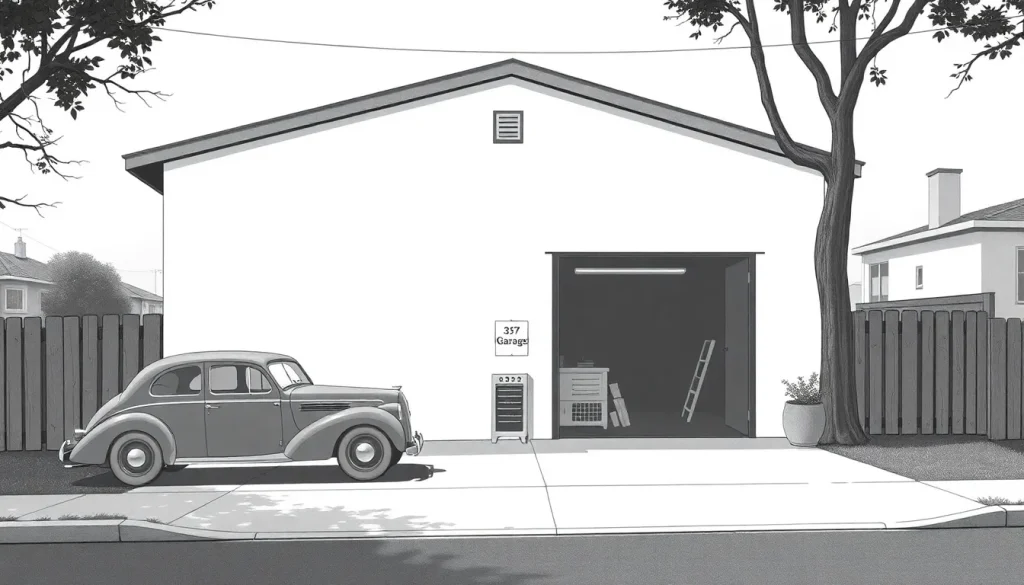
The original workshop lay within a quiet residential block of what is now central Palo Alto, at 367 Addison Avenue, between Waverley Street and Bryant Street. In the late 1930s, the neighborhood was a mix of modest California bungalows and Craftsman-style homes, shaded by mature oaks and elms. The property itself consisted of a two-story main house, a small rear cottage, and a detached one-car garage measuring approximately 12 by 18 feet. The garage faced a narrow alley, not the street, and was built of wood-frame construction with a simple gabled roof. The surrounding area, once part of the Rancho Rincon de San Francisquito land grant, had been subdivided into residential lots after the arrival of the railroad and the founding of Stanford University. Today, the house and garage remain largely intact, though the neighborhood has filled in with larger homes and the alley has been paved. The site is a short walk from the downtown Palo Alto Caltrain station and roughly two miles from the Stanford campus. What was once a quiet, tree-lined street of young families is now a pilgrimage destination for technology tourists, though the house itself remains a private residence, not open to the public.
Origins
The story of Hewlett-Packard begins not in the garage but in the classrooms and laboratories of Stanford University. William Redington Hewlett and David Packard met in 1934 as undergraduates in the electrical engineering program, where both fell under the influence of Professor Frederick Terman, a visionary who believed that the West Coast could support a homegrown electronics industry to rival the East. Terman encouraged his best students to think of themselves not merely as engineers but as potential entrepreneurs. In 1937, he arranged for Hewlett, Packard, and several classmates to tour East Coast radio and electronics firms, a trip that solidified their ambition to start a company.
The exact moment of the company’s conception is often placed in a series of discussions in Terman’s office and in the rented rooms the two men shared. Packard had taken a job at General Electric in Schenectady, New York, but returned to California in 1938. That year, he and his wife Lucile moved into the first-floor flat at 367 Addison Avenue, a house owned by a local widow who rented rooms to Stanford affiliates. Hewlett, who had remained in the area, moved into the small cottage behind the house. The garage, already equipped with a workbench and some tools, became their laboratory. According to Packard’s later recollections, the initial capital of $538 consisted of cash, a used drill press, and some hand tools. The name “Hewlett-Packard” was settled by a coin toss; Hewlett won the toss but deferred to Packard’s surname for the second position, a decision that Packard later claimed was made to avoid the appearance of a medical partnership.
The first product emerged from Hewlett’s graduate research on negative feedback oscillators. His design, which used a small incandescent bulb as a temperature-dependent resistor to stabilize the output, was simpler and cheaper than existing audio oscillators. Terman recognized its commercial potential and helped the partners refine the design. The resulting HP200A was priced at $54.40—a deliberate undercutting of the dominant General Radio oscillator, which sold for over $400. The first major order came from Walt Disney Studios, which purchased eight units (a slightly modified HP200B model) for testing and calibrating the multi-channel sound system used in Fantasia. Contemporary correspondence between Disney engineers and the fledgling company confirms the order, though some details of the transaction remain undocumented. No known photographs of the original workbench inside the garage survive from this period.
Growth and Community Life
The garage period was brief—barely a year—but it established patterns that would define the company for decades. Hewlett and Packard worked alongside a few early employees, including Lucile Packard, who handled bookkeeping and correspondence at the kitchen table. The workshop was cramped and unheated; Packard later recalled that they often worked late into the night, warmed only by a small electric heater and the intensity of their focus. The division of labor was informal: Hewlett concentrated on circuit design, while Packard managed production, procurement, and business relationships.
By 1940, the company had outgrown the garage. It moved to a small rented building at 481 Page Mill Road, near the Southern Pacific railroad tracks, and soon began hiring more staff. The early workforce was drawn largely from Stanford graduates and local technicians. The culture that emerged—later codified as “the HP Way”—emphasized respect for the individual, open communication, and a commitment to innovation. Contemporary newspaper accounts from the Palo Alto Times noted the arrival of the new firm with little fanfare; the city’s business pages were more concerned with agricultural processing and retail trade. Yet within a few years, HP had become a significant local employer, contributing to the transformation of Palo Alto from a university town into a center of light industry.
Relationship with Nearby Powers
The relationship between Hewlett-Packard and Stanford University was symbiotic from the start. Frederick Terman, who became dean of engineering and later provost, actively fostered ties between the university and local electronics firms. He encouraged HP to hire Stanford graduates, collaborate on research, and eventually lease land in the Stanford Industrial Park, which Terman conceived as a deliberate strategy to create a “community of technical scholars” where industry and academia would reinforce each other. HP was one of the first tenants of the park in the 1950s, cementing a model that would be replicated across Silicon Valley.
The city of Palo Alto, meanwhile, was initially ambivalent about industrial growth. Its early zoning ordinances reflected a desire to preserve a residential, low-density character. However, the success of HP and other startups gradually shifted local policy toward accommodating clean, research-oriented industry. The company’s presence also influenced the development of venture capital networks, law firms specializing in technology, and a culture of entrepreneurial risk-taking that distinguished Palo Alto from neighboring communities. Some historians argue that the city’s identity was fundamentally reshaped by HP’s success, though others note that the process was gradual and contested, with periodic debates over growth and congestion that continue to the present day.
Annexation, Decline, or Transformation
The garage at 367 Addison Avenue did not decline; it was simply left behind. After the company moved out in 1940, the property reverted to its original use as a private residence. For decades, the garage served as a storage space, its historical significance unrecognized except by a small circle of HP veterans and local historians. The house changed hands several times, and by the 1980s, the garage had fallen into disrepair, its wooden siding weathered and its roof sagging.
The transformation of the site from forgotten workshop to hallowed landmark began in earnest in the 1980s, as Silicon Valley’s origin story coalesced around the garage myth. In 1989, the State of California designated the garage as California Historical Landmark No. 976, with a bronze plaque affixed to the front of the property. The plaque’s text, however, contains a subtle inaccuracy: it identifies the site as the “Birthplace of Silicon Valley,” a term that did not exist in 1939 and that elides the contributions of other early firms such as Shockley Semiconductor, Fairchild, and Varian Associates. In 2000, HP itself, then a sprawling multinational, purchased the property and undertook a meticulous restoration, completed in 2005, that returned the garage, cottage, and house to their 1939 appearance based on photographs, original plans, and physical evidence. The property was listed on the National Register of Historic Places in 2007. Today, the house remains a private residence, managed by a trust, and is not open for interior tours. The garage can be viewed from the sidewalk, and a small interpretive sign provides context, though the experience is deliberately understated.
What Remains Today
A visitor to 367 Addison Avenue today will find a quiet, unassuming scene. The main house, a two-story shingled structure with a deep front porch, sits behind a low picket fence. The garage is tucked behind the house, visible from the alley but not from the street. The current building is the original structure, extensively restored: the wooden siding was repaired or replaced to match the original redwood, the roof was re-shingled, and the interior was refinished to evoke the workshop of 1939, though it is not furnished with original equipment. The bronze California Historical Landmark plaque is mounted on a stone pedestal near the sidewalk, not on the garage itself. A small sign on the fence reads “Birthplace of Silicon Valley” and directs visitors to respect the privacy of the residents.
It is important to note that the current building at 367 Addison Avenue should not be confused with the later HP headquarters buildings on Page Mill Road or the sprawling campus in Cupertino. The garage is the sole surviving physical artifact of the company’s founding moment. Nearby, at the corner of Addison and Waverley, a street sign marks “Hewlett-Packard Way,” a ceremonial designation. The HP Corporate Archives, located off-site, hold a small collection of artifacts from the period, including an original HP200A oscillator and early photographs, but these are not on public display. Oral histories collected by the Palo Alto Historical Association in the 1970s and 1980s capture the recollections of early employees and neighbors, though some details have faded with time.
Historical Photographs and Maps
The most iconic visual document of the garage is a black-and-white photograph taken in 1939 or 1940, showing the two founders standing in front of the open garage door. Hewlett is seated at a workbench, soldering iron in hand, while Packard stands beside him, arms crossed. The image, now held in the HP Corporate Archives, was likely staged for publicity purposes and has been widely reproduced. It reveals the garage’s simple wooden construction, the alley’s unpaved surface, and the informal attire of the young engineers. A 1940 Sanborn fire insurance map of Palo Alto shows the footprint of the house, cottage, and garage at 367 Addison, confirming the layout and the presence of the alley. The map also indicates the surrounding residential fabric, with similar small lots and outbuildings, underscoring how unremarkable the site appeared at the time. A third key source is a series of product photographs of the HP200A oscillator, taken against a plain backdrop, which document the device’s compact, utilitarian design. No known photographs of the interior of the garage during the working period survive; the earliest interior images date from the 1980s, after decades of alteration.
Historiographical Notes
The story of HP’s origins has been shaped by several layers of narrative construction. The earliest accounts, including company-published histories and the founders’ own memoirs (The HP Way, 1995), emphasize the garage as a humble but heroic starting point, a narrative that aligns with broader American myths of bootstrap entrepreneurship. These accounts tend to downplay the structural advantages the founders enjoyed: their Stanford education, Terman’s mentorship, and access to a network of capital and expertise. Later revisionist work by historians such as Christophe Lécuyer and Leslie Berlin has situated HP within a larger ecosystem of military contracting, federal research funding, and the deliberate economic development strategies of Stanford University. The designation of the garage as the “Birthplace of Silicon Valley” has been critiqued as an oversimplification that obscures the contributions of earlier radio and electronics firms in the Bay Area, as well as the crucial role of semiconductor companies that emerged later. Oral histories collected from early employees sometimes contradict the official narrative, revealing tensions over credit for the oscillator design and the extent of Lucile Packard’s contributions. The restoration of the garage itself has been interpreted by some scholars as an act of corporate myth-making, freezing a particular moment in time while erasing the building’s subsequent history as a lived-in residence.
Sources and Archives
The most important repository for primary sources on HP’s origins is the Hewlett-Packard Company Archives, now managed by the Hewlett Packard Enterprise Archives in San Jose. This collection includes early correspondence, product records, photographs, and the founders’ personal papers. The Stanford University Libraries hold the Frederick Terman Papers, which document his mentorship of Hewlett and Packard and his broader vision for the Stanford Industrial Park. The Palo Alto Historical Association maintains a vertical file on the HP garage, including newspaper clippings, oral history transcripts, and photographs of the property before and after restoration. The California Historical Resources Inventory database contains the nomination forms for both the state landmark and the National Register listing, which provide detailed architectural descriptions and historical context. For published works, the founders’ joint memoir The HP Way (HarperBusiness, 1995) remains an essential, if carefully curated, source. Michael S. Malone’s Bill & Dave: How Hewlett and Packard Built the World’s Greatest Company (Portfolio, 2007) offers a more critical, journalistic account. The Palo Alto Times digital archive, accessible through the Palo Alto City Library, contains contemporary coverage of the company’s early years, though references are sparse before 1945.
Related People and Places
Frederick Terman (1900–1982): Stanford professor, dean of engineering, and provost, often called the “father of Silicon Valley.” Terman’s mentorship of Hewlett and Packard and his creation of the Stanford Industrial Park were pivotal in transforming the region’s economy. His papers at Stanford reveal a deliberate strategy to retain engineering talent on the West Coast.
Lucile Packard (1914–1987): Dave Packard’s wife and an uncredited early contributor to HP. She managed the company’s books, handled correspondence, and provided the domestic stability that allowed the partnership to function. Her role is often minimized in official histories, though oral histories attest to her importance.
Walt Disney (1901–1966): The first major customer for HP’s audio oscillator. Disney’s purchase of eight HP200B units for Fantasia gave the fledgling company both credibility and cash flow. The transaction is documented in HP’s early sales records, though the exact date of the order is sometimes given as 1938 or 1939.
Stanford Industrial Park (now Stanford Research Park): Established in 1951 on university land, the park became HP’s long-term home and a model for suburban office parks worldwide. Its creation marked a deliberate shift in Stanford’s land-use policy from agricultural leases to high-tech industry.
481 Page Mill Road: The first rented building outside the garage, a small wooden structure near the railroad tracks. The building no longer exists; the site is now part of a larger commercial development. Contemporary photographs show a modest, shed-like building with a hand-painted sign.
FAQ
Where exactly is the HP garage located?
The garage is at 367 Addison Avenue, Palo Alto, California, behind the main house and visible from the alley. The house is a private residence and not open to the public, but the exterior can be viewed from the sidewalk.
What was HP's first product?
The first product was the HP200A audio oscillator, designed by Bill Hewlett. It used a light bulb as a temperature-dependent resistor to stabilize the circuit, making it simpler and cheaper than competing models.
Why is the garage called the 'Birthplace of Silicon Valley'?
The designation, formalized by a California state landmark plaque in 1989, reflects the garage's role as the starting point of Hewlett-Packard, one of the earliest and most influential technology companies in the region. However, historians note that the term 'Silicon Valley' was coined later and that many other firms contributed to the area's development.
Can I visit the inside of the garage?
No. The garage is part of a private residence and is not open for interior tours. The property was restored to its 1939 appearance by HP and is maintained by a trust, but public access is limited to exterior viewing.

Leave a Reply