Short Answer
Location
Gamble Garden is situated at 1431 Waverley Street, Palo Alto, California, within the prestigious Professorville Historic District. The 2.5-acre property occupies a tranquil residential block bounded by Waverley Street, Churchill Avenue, and Fulton Street, just a short walk from downtown Palo Alto and the Stanford University campus. Its coordinates are 37.4445° N, 122.1592° W. The garden is easily accessible via the Caltrain Palo Alto station, several VTA bus lines, and the Stanford Marguerite Shuttle, making it a convenient urban retreat.
Why It Is Significant
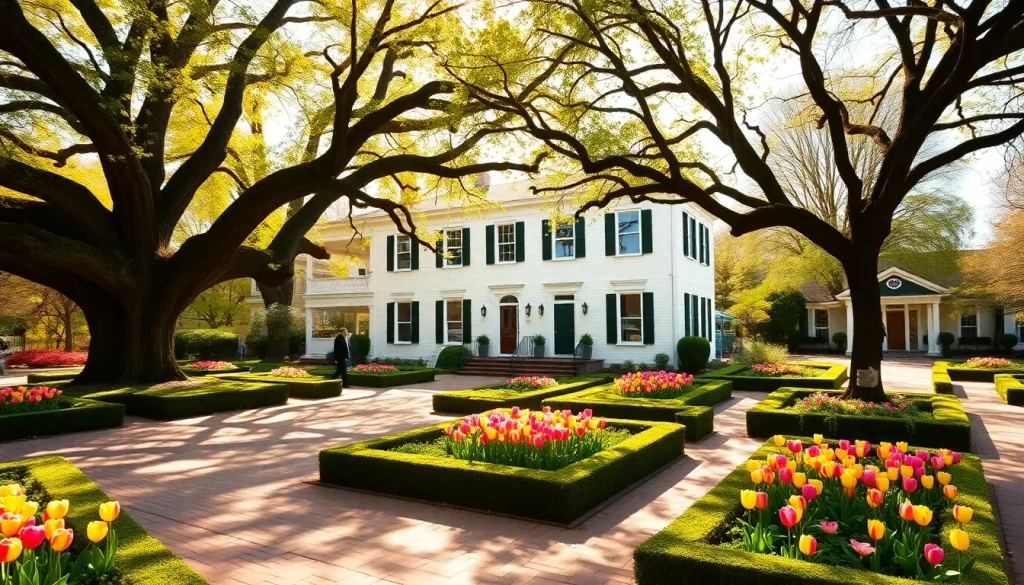
Gamble Garden stands as a rare surviving example of a early 20th-century estate in Palo Alto, seamlessly integrating a distinguished Colonial Revival residence with a series of meticulously designed gardens. It is significant for its association with the Gamble family, whose Procter & Gamble legacy provided the means to create this horticultural gem. Elizabeth Gamble’s 1981 bequest transformed the private family home into a public garden and community resource, ensuring its preservation and educational use. The site is a contributing property to the Professorville Historic District, listed on the National Register of Historic Places, and is recognized as a Palo Alto Historic Landmark. Today, it serves as a vibrant center for horticultural education, volunteerism, and community gatherings, hosting over 30,000 visitors annually.
Historical Timeline
| Year | Event |
|---|---|
| 1902 | Edwin and Elizabeth Gamble commission architect Charles Edward Hodges to design a Colonial Revival residence on a 2.5-acre parcel in the new Professorville subdivision. |
| 1908 | The Gambles move into the completed house, which features a formal parterre garden, orchard, and cutting garden. |
| 1920s–1940s | Elizabeth Gamble, an avid horticulturist, expands the gardens, adding rare plants and specimen trees. |
| 1981 | Elizabeth Gamble bequeaths the property to the City of Palo Alto, stipulating it be used as a public garden and community resource. |
| 1985 | The Garden Club of Palo Alto assumes management, restoring the gardens and opening them to the public. |
| 2002 | The house and gardens are designated a Palo Alto Historic Landmark. |
| 2008 | The property is listed as a contributing resource to the Professorville Historic District on the National Register of Historic Places. |
| 2015 | Major restoration of the historic house, including seismic retrofitting and period-accurate interior refurbishment, is completed. |
Architectural or Natural Characteristics
The Gamble House
The two-story residence is a refined example of Colonial Revival architecture, characterized by a symmetrical façade, a prominent central entrance with a pedimented portico, and a hipped roof with dormers. The exterior is clad in shiplap siding painted a soft cream, accented by dark green shutters. Inside, the house retains its original floor plan, featuring a grand central hall, formal living and dining rooms, and a library. Period-appropriate furnishings and family heirlooms, including Procter & Gamble memorabilia, are on display. The house serves as both a museum and a venue for private events.
The Gardens
The 2.5-acre landscape is divided into several distinct garden rooms, each demonstrating different horticultural styles and purposes:
- Formal Parterre Garden: A geometric arrangement of boxwood hedges and seasonal bedding plants, directly inspired by Elizabeth Gamble’s original design.
- Rose Garden: Features over 75 varieties of roses, including heirloom and modern cultivars, arranged in circular beds around a central fountain.
- Woodland Garden: A shaded retreat with mature oaks, camellias, ferns, and azaleas, showcasing plants suited to the California coastal climate.
- Cutting Garden: A working garden that supplies flowers for the house and educational programs, demonstrating succession planting techniques.
- Herb and Vegetable Garden: Raised beds filled with culinary and medicinal herbs, as well as seasonal vegetables, used in cooking demonstrations.
- Carriage House and Courtyard: A restored 1902 carriage house now serves as a classroom and event space, surrounded by a courtyard with container plantings.
Notable specimen trees include a massive coast live oak (Quercus agrifolia) estimated to be over 200 years old, a California buckeye, and several rare magnolias. The garden employs sustainable practices such as composting, integrated pest management, and water-wise irrigation.
Cultural Meaning
Gamble Garden embodies the early 20th-century vision of Palo Alto as a garden city, where prominent families built estate-like properties with extensive cultivated grounds. It reflects the philanthropic spirit of Elizabeth Gamble, who sought to share her love of horticulture with the community. The garden is a living classroom for sustainable gardening, a venue for cultural events, and a cherished green space that connects visitors to the area’s agricultural and domestic history. Its volunteer program, with over 200 active members, fosters a strong sense of community stewardship and continues the Gamble family’s legacy of service.
Visiting Information
Hours of Operation
- Gardens: Open daily from dawn to dusk, free of charge.
- House Tours: Docent-led tours are offered on select days; check the official website for the current schedule. A small donation is suggested.
- Office and Carriage House: Monday–Friday, 9:00 AM – 4:00 PM.
Admission
- Garden entry is free.
- House tours: $10 suggested donation for adults; children under 12 free.
- Special events and workshops may have separate fees.
Guided Tours
Docent-led garden tours are available for groups by reservation. Self-guided tour brochures can be picked up at the Carriage House. School and youth group tours are offered with advance booking.
Facilities
- Restrooms available in the Carriage House during office hours.
- Picnicking is permitted on the main lawn.
- Gift shop selling garden-related items and books.
- Free on-street parking on Waverley Street and Churchill Avenue.
Accessibility
The main garden paths are wide, level, and composed of decomposed granite or brick, making them wheelchair and stroller accessible. The historic house has a ramp entrance at the rear, and a wheelchair-accessible restroom is located in the Carriage House. However, some secondary garden paths may be narrow or uneven. Service animals are welcome. Accessible parking spaces are not designated, but curbside drop-off is available at the Waverley Street entrance.
Preservation Status
Gamble Garden is a designated Palo Alto Historic Landmark (2002) and a contributing property to the Professorville Historic District, which was listed on the National Register of Historic Places in 2008. The property is owned by the City of Palo Alto and managed by the Garden Club of Palo Alto under a long-term agreement. A comprehensive preservation plan guides all maintenance and restoration work. The 2015 house restoration, funded by a capital campaign, addressed structural issues, upgraded systems, and returned interior finishes to their 1902–1920 appearance. Ongoing garden preservation focuses on maintaining the historic plant palette while adapting to climate change and water conservation needs.
Common Misconceptions
Map
FAQ
Is there an admission fee to visit Gamble Garden?
No, the gardens are free and open to the public daily from dawn to dusk. House tours have a suggested donation of $10 for adults.
Can I take wedding or portrait photos at the garden?
Yes, photography for personal use is allowed without a permit. Professional portrait and wedding photography require a reservation and fee; contact the garden office for details.
Are dogs allowed?
Only service animals are permitted in the garden. Pets are not allowed to protect the plantings and wildlife.
What is the best time of year to visit?
Spring (March–May) offers the most dramatic floral displays, especially in the rose and parterre gardens. Fall brings beautiful foliage, and the garden is lovely year-round.
Is the garden wheelchair accessible?
Yes, the main paths are wheelchair and stroller friendly. The historic house has a ramp entrance, and an accessible restroom is available in the Carriage House.

Leave a Reply