Short Answer
One-Sentence Summary
Xerox PARC, established in 1970 on the edge of Stanford University’s lands, was the crucible in which the personal computer, graphical user interface, Ethernet, and laser printing were forged by a cadre of brilliant, often iconoclastic researchers, yet its parent company’s inability to recognize and commercialize these breakthroughs turned the lab into a symbol of squandered potential and a foundational seedbed for the entire personal computing industry.
Key Dates
| Date | Event |
|---|---|
| 1969 | Xerox Corporation decides to establish a corporate research center on the West Coast to explore the “architecture of information.” |
| July 1, 1970 | Xerox Palo Alto Research Center (PARC) officially opens at 3180 Porter Drive, Palo Alto, with a small group of researchers. |
| 1971 | Robert W. Taylor joins PARC from ARPA and begins building the Computer Science Laboratory, recruiting top talent. |
| 1973 | The Xerox Alto, the first computer designed from the ground up for a graphical user interface and mouse, becomes operational. |
| 1973 | Ethernet is invented by Robert Metcalfe and David Boggs, enabling local-area networking. |
| 1975 | PARC moves to its iconic, purpose-built facility at 3333 Coyote Hill Road in the Stanford Industrial Park. |
| 1979 | Steve Jobs and a team from Apple visit PARC and see the Alto’s GUI, Smalltalk, and networking, inspiring the Macintosh. |
| 1983 | Xerox begins to commercialize PARC’s laser printing technology with the Xerox 9700, a major financial success. |
| 2002 | PARC is spun off as an independent, wholly owned subsidiary of Xerox, renamed Palo Alto Research Center Incorporated. |
| 2023 | Xerox donates PARC to SRI International, ending its corporate lineage and merging it into the nonprofit research institute. |
Geographic Setting
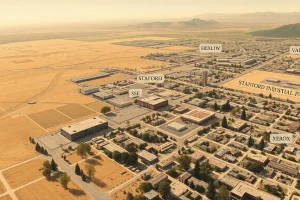
The original PARC facility occupied a leased building at 3180 Porter Drive, a modest office park in the flatlands of Palo Alto, just south of Oregon Expressway. In 1975, the lab moved to its custom-built home at 3333 Coyote Hill Road, perched on a gentle rise in the Stanford Industrial Park—now the Stanford Research Park—overlooking the Santa Cruz Mountains to the west and the baylands to the east. The site was deliberately chosen for its proximity to Stanford University, whose campus lay less than two miles away, and for its isolation from Xerox’s East Coast headquarters. The landscape was then a mix of open grassland, scattered oaks, and newly constructed low-rise research buildings. Today, the same building still stands, now occupied by SRI International, surrounded by mature landscaping and the dense concentration of technology firms that PARC’s own innovations helped spawn.
Origins
In the late 1960s, Xerox Corporation dominated the copier market but feared that the “paperless office” of the future would render its core business obsolete. To hedge against this, the company’s chief scientist, Jack Goldman, proposed a second research center, far from the corporate headquarters in Rochester, New York, and the existing Webster Research Center. The West Coast location was intended to tap into the emerging computer science talent pool around Stanford and to insulate researchers from the short-term demands of product divisions. The center was founded as the Xerox Palo Alto Research Center, with its first director, George Pake, a physicist and former provost of Washington University. Pake’s mandate was to create a world-class research institution that would explore the “architecture of information”—a deliberately vague charter that gave the lab extraordinary intellectual freedom. The exact date of the first research group’s formation is disputed, with some sources pointing to late 1969, but the official opening is recorded as July 1, 1970.
Growth and Community Life
PARC’s golden age began in 1971 when Robert W. Taylor, a former director of the Information Processing Techniques Office at ARPA, joined to lead the Computer Science Laboratory. Taylor recruited a remarkable cohort of young researchers, many of them graduates of the ARPA-funded computer science programs at Stanford, MIT, and Utah. The lab’s culture was famously flat and non-hierarchical; researchers were encouraged to pursue their own projects, and the weekly “Dealer” meetings—named after Taylor’s preferred term for distributing ideas—became legendary forums for intense debate and demonstration. Beanbag chairs, informal dress, and a fierce intellectual competitiveness defined daily life. By 1973, the lab had produced the Alto, a revolutionary personal computer with a bitmapped display, mouse, and overlapping windows; the Ethernet networking protocol; and the first laser printer. Smalltalk, the object-oriented programming language and environment developed by Alan Kay’s Learning Research Group, introduced the graphical user interface and the desktop metaphor. Contemporary internal memos reveal a sense of mission bordering on utopianism: the researchers believed they were not just building machines but reshaping how people thought and communicated. At its peak in the mid-1970s, PARC housed about 300 researchers and staff, a self-contained community of computer scientists, physicists, and engineers who often worked late into the night, sustained by a shared vision of a networked, interactive future.
Relationship with Nearby Powers
PARC’s relationship with its parent company, Xerox, was fraught from the start. The headquarters in Stamford, Connecticut, and the copier divisions in Rochester viewed the Palo Alto lab with a mixture of pride and suspicion. The “toner heads”—as the copier engineers were sometimes called—could not grasp the significance of a computer that did not print on paper. Meanwhile, PARC’s proximity to Stanford created a porous boundary; many researchers held consulting positions or taught courses, and Stanford students and faculty frequently visited the lab. The relationship with the emerging Silicon Valley venture capital ecosystem was equally complex. PARC’s famous open-door policy for visitors, including Steve Jobs and Bill Gates, led to the transfer of its key ideas to Apple and Microsoft with little legal or financial recompense. According to internal Xerox documents, the company’s senior management failed to understand the personal computer market, seeing the Alto as a costly research tool rather than a consumer product. This cultural and geographic distance—three thousand miles and a different business paradigm—meant that PARC’s inventions were often orphaned, lacking a champion within the corporate hierarchy.
Annexation, Decline, or Transformation
The decline of PARC as a pure research institution was gradual and driven by the departure of its key talent. Frustrated by Xerox’s inability to commercialize their work, many of the lab’s brightest stars left in the early 1980s. Charles Simonyi joined Microsoft to develop Word and Excel; John Warnock and Charles Geschke founded Adobe Systems, based on PARC’s Interpress page description language; Robert Metcalfe left to found 3Com and commercialize Ethernet. The 1979 Apple visit, in which Steve Jobs saw the GUI and mouse, is often cited as the moment the future slipped from Xerox’s grasp. However, Xerox did eventually profit from PARC’s laser printing technology, which became a multibillion-dollar business. In 2002, Xerox spun off PARC as an independent, wholly owned subsidiary, tasked with generating revenue through contract research and licensing. The lab’s focus shifted from pure research to applied innovation for corporate and government clients. The final transformation came in 2023, when Xerox donated the institution to SRI International, a nonprofit research institute with deep roots in the same ARPA-funded computer science community that had spawned PARC. The legal transfer was completed without public fanfare, marking the end of PARC’s identity as a Xerox entity.
What Remains Today
The building at 3333 Coyote Hill Road still stands, its low-slung, modern architecture largely unchanged from 1975. The current occupant, SRI International, maintains some of the original interior features, including the open-plan layout and the iconic central staircase. A small display in the lobby commemorates PARC’s history, featuring a replica of the Alto and a plaque listing key inventions. The original beanbag chairs are long gone, but the spirit of informal collaboration persists in the building’s design. Outside, the landscaping has matured, and the surrounding Stanford Research Park is now home to dozens of technology companies, many of which trace their lineage directly to PARC alumni. The current building should not be confused with the original Porter Drive site, which has been remodeled and now houses other tenants. For the dedicated visitor, the Computer History Museum in Mountain View holds several original PARC artifacts, including an Alto, an Ethernet transceiver, and a laser printer prototype. No known photographs of the original Porter Drive lab interior survive, but oral histories collected by the museum provide vivid descriptions of the cramped, windowless rooms where the first Alto was assembled.
Historical Photographs and Maps
A 1975 architectural rendering of the Coyote Hill Road building, held in the Stanford University Archives, shows the original design intent: a low, horizontal structure integrated into the hillside, with a central courtyard and a reflecting pool that was never built. A series of candid photographs taken by PARC researcher Alan Kay in 1973, now in the collection of the Computer History Museum, document the Alto’s development environment, including the prototype mouse and the first bitmap display. A 1980 Sanborn fire insurance map of the Stanford Industrial Park shows the PARC building as the sole occupant of its parcel, surrounded by undeveloped land—a stark contrast to the dense campus that exists today. These visual sources reveal the lab’s physical isolation and its deliberate separation from the commercial world, a condition that was both its greatest strength and its ultimate vulnerability.
Historiographical Notes
The dominant narrative of PARC is encapsulated in the title of the 1988 book Fumbling the Future: How Xerox Invented, Then Ignored, the First Personal Computer by Douglas K. Smith and Robert C. Alexander. This account, written with the cooperation of many PARC alumni, emphasizes Xerox’s managerial myopia and the tragic loss of a technological lead. However, revisionist historians have challenged this narrative, pointing out that Xerox did successfully commercialize the laser printer and that the personal computer market was not yet mature in the mid-1970s. Some argue that PARC’s real legacy is not the products it failed to sell but the people it trained and the ideas it disseminated, which became the foundation of the entire personal computing industry. Early corporate histories of Xerox, written by company insiders, tend to downplay the internal conflicts and emphasize the lab’s contributions to the company’s bottom line. More recent scholarship, drawing on oral histories and declassified internal memos, presents a more nuanced picture of a creative community caught between two incompatible corporate cultures.
Sources and Archives
The most important repository for PARC history is the Computer History Museum in Mountain View, which holds an extensive collection of oral histories with key figures, including Robert Taylor, Alan Kay, and Charles Simonyi, as well as original hardware and software. The Stanford University Libraries’ Department of Special Collections houses the papers of several PARC alumni and the records of the Stanford Industrial Park. The Xerox Corporation archives in Rochester, New York, contain internal reports, patent filings, and correspondence, though access is restricted. The Charles Babbage Institute at the University of Minnesota holds a significant collection of interviews and documents related to the history of computing, including the ARPA community from which PARC emerged. For published sources, Michael Hiltzik’s Dealers of Lightning: Xerox PARC and the Dawn of the Computer Age (1999) remains the most comprehensive narrative history, based on extensive interviews with the participants.
Related People and Places
Robert W. Taylor (1932–2017): The visionary manager who built PARC’s Computer Science Laboratory and created its unique culture. Taylor’s earlier work at ARPA had funded the development of the ARPANET, and his ability to identify and recruit exceptional talent was legendary. Alan Kay (b. 1940): The computer scientist who conceived the Dynabook, a portable personal computer for children, and led the team that developed Smalltalk and the overlapping window interface. Kay’s ideas about learning and computing continue to influence educational technology. Charles Simonyi (b. 1948): The Hungarian-born programmer who developed Bravo, the first WYSIWYG word processor, at PARC, and later joined Microsoft to create Word and Excel. John Warnock (b. 1940) and Charles Geschke (1939–2021): The founders of Adobe Systems, who developed the Interpress page description language at PARC, which evolved into PostScript and revolutionized desktop publishing. Related places: The Stanford Artificial Intelligence Laboratory (SAIL), where many PARC researchers had previously worked and which provided a model for the lab’s collaborative culture; Apple’s original headquarters at 20525 Mariani Avenue in Cupertino, where the Macintosh team attempted to replicate PARC’s GUI; and the Xerox Webster Research Center in New York, the older sibling that represented the company’s traditional copier-focused research culture.
FAQ
What does PARC stand for?
PARC originally stood for Palo Alto Research Center, reflecting its location. After being spun off as an independent subsidiary in 2002, it was officially renamed Palo Alto Research Center Incorporated, though the acronym PARC was retained.
Did Xerox really give away the personal computer?
The narrative is more nuanced. Xerox failed to commercialize the Alto as a mass-market product, but it did profit enormously from the laser printer technology developed at PARC. The ideas and talent that left PARC were instrumental in creating the personal computer industry, but Xerox's management did not see the Alto as a viable consumer product at the time.
What is the most important invention from PARC?
While the graphical user interface and the personal computer are the most famous, the laser printer was PARC's most commercially successful invention for Xerox. Ethernet, as the foundation of local-area networking, arguably had the broadest long-term impact on the world.
Is the original PARC building still there?
Yes, the building at 3333 Coyote Hill Road in Palo Alto still stands and is now occupied by SRI International. It retains much of its original exterior appearance and some interior features, though it has been renovated over the decades.
Leave a Reply